
Published: Feb 20, 2026
J2 EAD Validity Period: How Long Is It Valid?
Your J-2 EAD is valid for 1-2 years or until your spouse's DS-2019 expires. Learn what determines your validity period and how to avoid work gaps.

By Alicja
Your J-2 EAD is valid for 1-2 years or until your spouse's DS-2019 expires—whichever comes first. Here's how to maximize your validity period and avoid work authorization gaps.

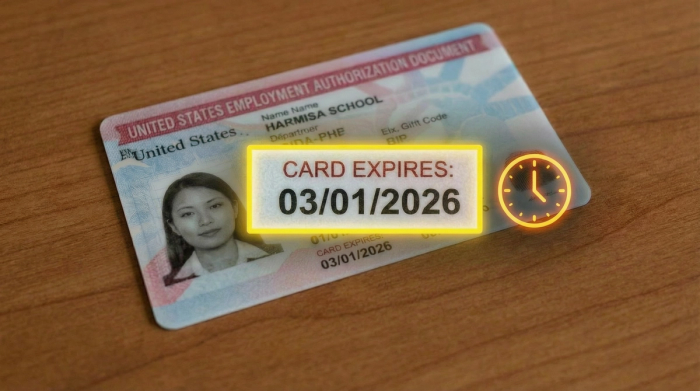
Your J-2 EAD is valid for 1-2 years or until your spouse's DS-2019 expires - whichever comes first. How to maximize your validity period and avoid work authorization gaps.
A J-2 EAD typically lasts 1-2 years, but your exact expiration date depends on how long the J-1 principal maintains J-1 status (and, in practice, the program end date on the J-1's DS-2019). Under the regulations, J-2 employment may be authorized for the duration of the J-1 principal's authorized stay as indicated on Form I-94 or a period of 4 years, whichever is shorter (8 CFR § 214.2(j)(1)(v)(B)). The most critical thing to understand: J-2 EADs do not qualify for automatic extensions, so when your card expires, your work authorization ends immediately.
What Determines Your J-2 EAD Validity Period?
Your J-2 EAD validity period is controlled by two factors: USCIS discretion and the J-1 principal's period of authorized stay (reflected as D/S on the I-94 and supported by a valid DS-2019), with J-2 employment authorization capped at 4 years (8 CFR § 214.2(j)(1)(v)(B); 8 CFR § 274a.12(c)(5)).
The key rule: Your J-2 employment authorization cannot be granted beyond the J-1 principal's authorized stay (as indicated on the J-1's Form I-94) and cannot exceed 4 years (8 CFR § 214.2(j)(1)(v)(B)). In practice, USCIS generally will not issue a J-2 EAD past the J-1's current DS-2019 end date, so if your spouse's DS-2019 expires in 18 months, your EAD is typically limited to about 18 months - even though the regulations allow up to 4 years maximum.
In practice, most J-2 EADs are issued for 1-2 years. The exact duration depends on:
- The J-1's DS-2019 end date - This is the hard ceiling
- USCIS adjudicator discretion - Officers can approve shorter periods
- Program type - Research scholars and professors often have longer DS-2019s than short-term trainees
Important: If your spouse plans to extend their J-1 program, have them extend the DS-2019 before you apply for your J-2 EAD. A longer DS-2019 means a longer potential EAD validity period.
How Your DS-2019 Determines Your EAD Expiration Date
The relationship between your EAD and the J-1's DS-2019 is straightforward but often misunderstood.
Your J-2 employment authorization may be authorized only for the duration of the J-1 principal's authorized stay (as indicated on Form I-94) or a period of 4 years, whichever is shorter (8 CFR § 214.2(j)(1)(v)(B)). In practice, USCIS generally will not issue a J-2 EAD beyond the J-1's current DS-2019 end date. If the J-1 completes their program early or changes to a different visa status, your J-2 EAD becomes invalid immediately - even if the expiration date printed on your card hasn't arrived yet.
Examples:
The strategy here is clear: If possible, have the J-1 principal extend their DS-2019 as far out as possible before you file Form I-765. A two-year DS-2019 gives you the chance for a two-year EAD. A five-month DS-2019 limits you to a five-month card.
Can You Get a Multi-Year J-2 EAD?
Yes, though it's not guaranteed. Under the regulations, J-2 employment may be authorized for the duration of the J-1 principal alien's authorized stay as indicated on Form I-94 or a period of 4 years, whichever is shorter (8 CFR § 214.2(j)(1)(v)(B)).
To maximize your chances of getting a multi-year EAD:
- Ensure the DS-2019 has maximum validity - Ask the J-1 sponsor to issue or extend the DS-2019 for the full program duration before you file
- File with complete documentation - Incomplete applications may result in shorter validity periods
- Be in valid J-2 status - Maintain your status throughout the application process
That said, even with a DS-2019 valid for several years, USCIS often issues 1-2 year cards. You have no control over this - the adjudicator makes the final decision on validity period.
The upside: A shorter EAD doesn't prevent you from renewing your J-2 EAD when it expires. It just means you'll need to renew more frequently.
Check Your J-2 EAD Eligibility
Find out if you qualify for J-2 work authorization in about 2 minutes.
Why J-2 EADs Don't Have Automatic Extensions
This is the most critical rule that many J-2 dependents don't know: J-2 EADs do not qualify for automatic extensions.
Some EAD categories (like H-4, L-2, and pending adjustment of status) previously received automatic 180-day or 540-day extensions when they filed timely renewal applications. This allowed people to keep working while waiting for their new card.
J-2 EADs in category (c)(5) have never been eligible for this automatic extension (USCIS I-9 Central Handbook).
What this means in practice:
- When your J-2 EAD expires, your work authorization ends that day
- Filing a renewal application does not extend your ability to work
- You cannot legally work during the gap between your old EAD expiring and receiving the new one
- Your employer must stop paying you once your EAD expires
The Oct. 30, 2025 rule change that eliminated automatic extensions for categories that previously qualified doesn't directly affect J-2 holders because category (c)(5) was never eligible in the first place. But it's a reminder that you cannot rely on any automatic bridge - your planning must account for current processing times and potential gaps.
Warning: If you work after your EAD expires, you're working without authorization. This can affect your immigration status and future applications. Don't risk it.
When to Apply for J-2 EAD Renewal
You can file your J-2 EAD renewal up to 180 days (about 6 months) before your current card expires. Because USCIS processing times vary, filing as close to the 180-day mark as possible is essential if you want to avoid work gaps.
Recommended timeline:
The 180-day rule isn't just a suggestion - it's your safety net. USCIS backlogs remain significant, and processing times can shift unpredictably. Filing early gives your application the maximum time to be adjudicated before your current authorization expires.
Gap Avoidance Strategies for J-2 EAD Holders
Because J-2 EADs don't qualify for automatic extensions, gap avoidance requires careful planning. A step-by-step approach:
6 months before EAD expires:
- Confirm the J-1's DS-2019 is valid beyond your target EAD renewal period
- If the DS-2019 needs extension, the J-1 should request it from their program sponsor now
5 months before EAD expires:
- Gather all required documents for I-765
- Obtain updated I-94, passport copies, and J-1 DS-2019 copies
- Confirm your A-Number and previous EAD information
180 days before EAD expires:
- File Form I-765 with the current filing fee ($520 for paper filing)
- Pay using credit/debit card (Form G-1450) or ACH transfer (Form G-1650) - as of Oct. 28, 2025, USCIS no longer accepts paper checks or money orders for paper-filed forms (unless an exemption applies).
During processing:
- Check your case status weekly
- Respond immediately to any RFE (Request for Evidence)
- Do not travel internationally if possible, as it could complicate your case
If your EAD expires before approval:
- Stop working on your expiration date
- You cannot legally work until you receive the new card
- Continue checking your case and consider expedite options if eligible
The most common mistake is waiting too long to file. Don't assume processing times will be fast. Plan for worst-case scenarios.
Ready to Apply for Your J-2 EAD?
Immiva guides you through every step of Form I-765 with plain-English instructions and automatic error checking.
What Happens When the J-1 Principal's Status Changes
Your J-2 EAD is directly tied to the J-1 principal's status. When their status changes, your work authorization is affected - sometimes immediately.
If the J-1 program ends early:
Your EAD becomes invalid when the J-1 completes their program, even if the date on your card hasn't arrived. The DS-2019 end date is the ceiling, but actual program completion is the trigger.
If the J-1 changes to H-1B or another status:
Your J-2 status ends when the J-1 changes status. Your J-2 EAD becomes invalid immediately. You would need to change to an appropriate dependent status (like H-4) and apply for a new EAD under that category if eligible.
If the J-1 transfers to a different institution:
The new institution must issue a new DS-2019. Your J-2 EAD remains valid as long as the J-1 maintains J-1 status and your EAD hasn't expired. However, always verify your J-2 status is properly documented with the new program.
If the DS-2019 is extended:
Good news: The J-1 can extend their program. However, extending the DS-2019 does not automatically extend your EAD. You must file a completely new I-765 application to get a new EAD reflecting the extended DS-2019 dates.
Current J-2 EAD Processing Times (2026)
J-2 EAD processing times typically range from 1-5 months, though some cases take longer. Processing times vary by service center and fluctuate throughout the year.
Your application is assigned to a service center based on your state of residence after being received at a USCIS lockbox facility.
Tips for potentially faster processing:
- J-2 EAD applications are not eligible for online filing, so you must file Form I-765 by mail.
- Ensure your application is complete with all required evidence
- Respond to any correspondence immediately
- Track your case status and contact USCIS if processing exceeds posted times
Premium processing is not available for J-2 EAD applications. The only way to potentially speed up a pending case is through an expedite request, which requires meeting specific criteria.
J-2 EAD Validity vs. Other EAD Categories
J-2 EADs have some important differences compared to other dependent work permits. Understanding these helps you plan effectively.
The key takeaway: All dependent EAD categories now face similar challenges without automatic extensions. But J-2 holders never had that safety net, so the discipline of early filing and gap planning has always been essential for this category.
Frequently Asked Questions
J-2 EADs are typically valid for 1-2 years, but the exact validity depends on USCIS discretion and how long the J-1 principal maintains J-1 status (and, in practice, the current DS-2019 end date). Under the regulations, J-2 employment may be authorized for the duration of the J-1 principal's authorized stay as indicated on Form I-94 or a period of 4 years, whichever is shorter (8 CFR § 214.2(j)(1)(v)(B)).
No. Your J-2 EAD validity cannot exceed the J-1's DS-2019 program end date (8 CFR § 214.2(j)(1)(v)). If the DS-2019 expires in 8 months, your EAD can only be valid for up to 8 months.
No. When the J-1 extends their DS-2019, you must file a completely new I-765 application to get a new EAD reflecting the extended dates. There is no automatic extension.
No. J-2 EAD category (c)(5) does not qualify for automatic extensions. When your current EAD expires, your work authorization ends immediately, even if you've filed a renewal application. You must stop working until you receive the new card.
You can file your renewal up to 180 days (about 6 months) before your current EAD expires. Given processing times of 1-5 months, filing at the 180-day mark is strongly recommended to avoid gaps.
You cannot legally work during this gap. You must stop working on your expiration date and wait until you receive your new EAD. This is why filing 180 days early is critical. For urgent situations, you may be able to submit an expedite request.
Under the regulations, J-2 employment may be authorized for the duration of the J-1 principal's authorized stay as indicated on Form I-94 or a period of 4 years, whichever is shorter (8 CFR § 214.2(j)(1)(v)(B)). However, many J-2 EADs are issued for shorter periods in practice.
Yes. Your J-2 EAD is tied to the J-1 principal's J-1 status. When they change to H-1B, your J-2 status ends, and your J-2 EAD becomes invalid immediately - even if the expiration date hasn't arrived.
No. The 212(e) requirement doesn't affect J-2 EAD eligibility or validity. You can still obtain and use an EAD while subject to 212(e). The requirement only restricts your ability to change to certain visa statuses or apply for a green card.
The filing fee is $520 for paper filing. (Online filing is not available for J-2 EAD applications.) You must pay using credit/debit card (Form G-1450) or ACH bank transfer (Form G-1650) - as of Oct. 28, 2025, USCIS no longer accepts paper checks or money orders for paper-filed forms (unless an exemption applies).
No. Premium processing is not available for J-2 EAD applications. If you have an urgent need, you may request an expedite based on specific criteria, but there's no guaranteed fast-track option.
Stop working immediately on your expiration date. Continue checking your case status. If processing is taking longer than posted times, you can contact USCIS or submit an expedite request if you qualify. Never work without valid authorization.
Official Sources
This guide is based on current USCIS policy and federal regulations. All information was verified against these official sources as of February 2026:
USCIS Resources
- USCIS Form I-765 Official Page - Form instructions and filing information
- USCIS I-765 Instructions PDF - Category (c)(5) requirements
- USCIS Policy Manual Volume 10 - Employment authorization policies
- USCIS I-9 Central: Automatic Extensions - Categories eligible for auto-extension (J-2 NOT included)
- USCIS Processing Times - Current wait times by form and service center
- USCIS Fee Schedule - Current filing fees
Federal Regulations
- 8 CFR § 274a.12(c)(5) - J-2 EAD eligibility classification
- 8 CFR § 274a.13 - EAD application procedures and validity rules
- 8 CFR § 214.2(j)(1)(v) - J-2 employment authorization conditions
Federal Register
- Removal of Automatic Extension of EADs (October 30, 2025) - Interim Final Rule eliminating auto-extensions
Immigration law changes frequently. We monitor USCIS policy updates and revise this guide when regulations change.
About Immiva
Simplifing Immigration Process
Resources
Contact
Disclaimer: Simple Immi LLC dba Immiva is not a lawyer or a law firm and does not engage in the practice of law, provide legal advice, or offer legal representation. The information, software, services, and comments on this site are for informational purposes only and address issues commonly encountered in immigration. They are not intended to be a substitute for professional legal advice. Immiva is not affiliated with or endorsed by the United States Citizenship and Immigration Services (USCIS) or any other government agency. Your use of this site is subject to our Terms of Use.
Copyright © 2025 immiva.com (Simple Immi LLC dba Immiva)