
Published: Feb 03, 2026
J-2 EAD Processing Time 2026: Current Wait Times by Service Center
How long will you wait for your J-2 work permit? Current processing times range from 2-5 months, but recent policy changes make timing more critical than ever.

By Alicja
J-2 EAD processing takes 3-5 months on average in 2026. Get current wait times by service center, understand policy changes, and learn how to track your case.

Getting work authorization as a J-2 dependent spouse or child means waiting. And that wait can feel endless when you don't know what to expect.
Right now, J-2 EAD processing typically takes 2-5 months, but your actual timeline depends heavily on which USCIS service center handles your case. Some centers process cases in weeks while others take half a year.
USCIS policy changes in 2025 mean gaps in employment authorization can now affect your status. Understanding current processing times helps you plan your job search, negotiate start dates, and decide whether expedite requests make sense.
Current J-2 EAD processing times in 2026
USCIS publishes official processing times, but real-world data shows a different picture. What J-2 applicants are actually experiencing based on university international offices and applicant reports:
These times measure from when USCIS receives your application to when they mail your decision. Add 1-2 weeks for mail delivery of your physical EAD card.
Important: Processing times change monthly. Check USCIS processing times directly before planning.
What affects J-2 EAD processing time?
Several factors determine whether you'll wait two months or six:
Service center assignment: You don't choose which center processes your case, but your mailing address influences it. The Potomac Service Center in Virginia handles most J-2 cases from eastern states.
Application completeness: Missing documents or signatures trigger Requests for Evidence (RFEs), adding 2-4 months to your timeline. USCIS must receive your response within the deadline, and then your case goes back in the queue.
Time of year: Processing slows during peak filing seasons. Many J-2 applicants file in summer when J-1 researchers start new positions, creating backlogs from August through October.
Background checks: If your case requires additional security screening, processing extends indefinitely. This is rare for J-2 applicants but can happen.
USCIS workload: Overall agency backlogs affect all case types. When USCIS prioritizes other categories, J-2 EADs may sit longer.
What is a J-2 EAD?
A J-2 Employment Authorization Document is a work permit issued to J-2 visa holders, the dependent spouses and unmarried children under 21 of J-1 exchange visitors.
Unlike J-1 visa holders who have work authorization tied to their program, J-2 dependents need separate permission to work in the United States. The J-2 EAD provides this authorization.
The legal basis comes from 8 CFR 274a.12(c)(5), which allows J-2 dependents to apply for employment authorization as long as the income isn't needed to support the J-1 principal.
Key characteristics of the J-2 EAD:
- Allows any type of employment, full-time or part-time
- Valid for the same duration as the J-1's DS-2019 or up to 2 years, whichever is shorter
- Requires renewal before expiration to maintain work authorization
- Does not provide a path to permanent residence on its own
- Can be used for self-employment and starting a business
For more details on J-2 work authorization basics, see our complete guide to J-2 visa work authorization.
J-2 EAD eligibility requirements
To qualify for a J-2 EAD, you must meet these requirements:
Valid J-2 status: Your J-2 visa and DS-2019 must be current. You cannot apply if your J-1 principal's program has ended.
J-1 in valid status: The J-1 principal must maintain their exchange visitor status. If they violate program terms, your J-2 status is affected.
Income not needed for support: This requirement confuses many applicants. You must demonstrate that your employment income won't be used to support the J-1 principal. This doesn't mean you can't contribute to household expenses but rather that the J-1's program provides sufficient support without your income.
No employment without EAD: You cannot begin working before receiving your EAD card. Even if your application is pending, working without the physical card violates your status.
Physical presence: You must be in the United States to apply and receive your EAD.
Required documents for J-2 EAD
Gather these documents before starting your application:
Form I-765: The Application for Employment Authorization. Use the most current version from uscis.gov.
Two passport-style photos: Taken within 30 days, following USCIS photo requirements. White background, no glasses, direct front view.
Copy of your passport: The biographical page and any pages with U.S. visas or stamps.
Copy of your J-2 visa: The visa stamp in your passport.
Copy of your DS-2019: Both yours and the J-1 principal's current DS-2019 forms.
Copy of J-1's most recent pay stub or funding letter: Evidence that the J-1's program provides adequate support.
Financial statement: A brief letter explaining that your income won't be used to support the J-1, often combined with evidence of the J-1's funding.
Copy of your I-94: Your arrival/departure record, available online at cbp.gov.
Copy of previous EAD (if renewal): If you're renewing, include a copy of your current or most recent EAD.
Filing fees and payment methods (2026)
As of 2026, the J-2 EAD application requires:
Ready to apply for your J-2 EAD?
Immiva helps you prepare a complete, accurate application. Our guided system catches common mistakes before you file, giving you the best chance for smooth processing.
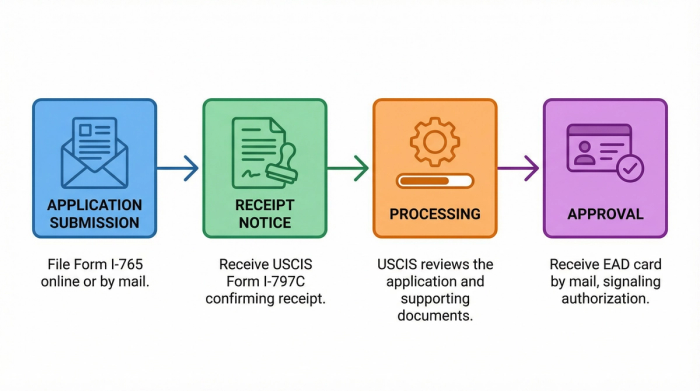
J-2 EAD timeline: What happens after you apply
What to expect at each stage:
Week 1-3: Receipt notice arrives. Your official processing clock starts when USCIS receives your application.
Week 2-4: Biometrics notice (if required). Not all applicants receive this. If you do, attend your appointment as scheduled.
Month 1-3: Active review period. Your case is assigned to an officer who reviews your documents and eligibility.
Month 2-5: Decision made. If approved, status changes to "Card Is Being Produced." If there are issues, you may receive an RFE.
1-2 weeks after approval: Card mailed and delivered. Your EAD arrives by USPS to the address on your application.
Critical 2025-2026 policy changes affecting J-2 EAD
Recent policy changes make timing more important than ever:
Automatic extension changes: The 180-day automatic extension for EAD renewals has specific requirements. Your renewal must be filed before your current EAD expires, and it must be for the same eligibility category. J-2 applicants renewing under category (c)(5) qualify, but gaps in status can disrupt this protection.
Processing time fluctuations: USCIS has shifted resources between case types, causing some categories to slow while others speed up. J-2 cases have remained relatively stable but can be affected by broader agency priorities.
Premium processing not available: Despite expansion of premium processing to other EAD categories, J-2 EADs still don't qualify. You cannot pay extra for faster processing.
Digital EAD consideration: USCIS has discussed digital EAD options but hasn't implemented them for initial applications. Physical cards remain the standard.
Can you expedite J-2 EAD processing?
Yes, but approval isn't guaranteed. USCIS considers expedite requests based on specific criteria:
Severe financial loss: If you'll lose a job offer or face significant financial hardship without faster processing. Document this with offer letters and deadline information.
Emergency situations: Medical emergencies, humanitarian reasons, or urgent circumstances beyond your control.
Nonprofit organization request: If a nonprofit has an urgent need for your services.
U.S. government interest: Rare for J-2 cases but possible if your work serves government interests.
USCIS error: If delays result from USCIS mistakes.
To request expedited processing:
- Wait until you have your receipt number
- Call the USCIS Contact Center or submit an online inquiry
- Provide detailed evidence supporting your request
- Be prepared for denial and have backup plans
For detailed guidance on expedite requests, see our comprehensive J-2 EAD expedite request guide.
What to do if your J-2 EAD is delayed
If your case exceeds normal processing times:
Check the USCIS processing time website: Times change monthly. Your case might still be within the current published range.
Submit an e-Request: Through the USCIS website, you can ask about cases outside normal processing times. You'll receive a response within 30 days.
Contact your congressperson: Congressional inquiries can prompt USCIS to review stuck cases. This doesn't guarantee faster processing but adds another review layer.
Consult with an attorney: If your case has been pending significantly longer than average, or if you received an RFE you don't understand, professional help may be worthwhile.
Document everything: Keep copies of all communications with USCIS. Note dates you called and what representatives told you.
Don't work without authorization: Even if your case is severely delayed, working without your EAD violates your status. This can affect future applications and your ability to remain in the U.S.
J-2 EAD renewal: When and how to apply
Start your renewal process early, ideally 4-6 months before your current EAD expires.
Renewal timeline:
- 180 days before expiration: Earliest you can file
- 120 days before expiration: Recommended filing window
- 90 days before expiration: File immediately
- After expiration: Emergency situation, file with explanation
Automatic extension: If your current EAD is in category (c)(5) and you file a timely renewal, you receive an automatic 180-day extension of your work authorization. This applies even while your renewal is pending.
Required for renewal:
- Same documents as initial application
- Copy of current EAD (front and back)
- Explanation if circumstances have changed
For complete renewal instructions, see our J-2 EAD renewal guide.
Don't let your EAD expire
Immiva tracks your EAD expiration and reminds you when it's time to renew. Start your renewal application with your previous information pre-filled.
Common mistakes that delay J-2 EAD processing
Avoid these errors that applicants frequently make:
Wrong eligibility category: J-2 applicants must select category (c)(5). Using the wrong code results in denial.
Insufficient financial evidence: Simply stating the J-1 has funding isn't enough. Include actual documentation like appointment letters or pay stubs.
Expired DS-2019: If your DS-2019 expires before you apply, you'll need to get it extended first.
Photos not meeting requirements: USCIS rejects applications with photos that don't meet exact specifications. When in doubt, have them taken professionally.
Unsigned forms: Physical applications must have original signatures. Electronic signatures aren't accepted on mailed forms.
Missing pages: When copying your passport, include all pages with stamps or visas, not just the photo page.
Wrong filing address: USCIS changes lockbox addresses periodically. Use the address from the current I-765 instructions, not an old address you may have saved.
Applying too early: You can't file more than 180 days before your current EAD expires (for renewals) or more than 120 days before your J-2 status start date (for initial applications).
Frequently Asked Questions
Current processing times range from 2-5 months depending on your service center. Most applicants receive their EAD within 3-4 months. Check USCIS processing times for the most current estimates.
Only if you have valid work authorization from a previous EAD with an automatic extension. Initial applicants cannot work until they receive their EAD card. The physical card must be in your hands.
No. Despite expansion of premium processing to many EAD categories, J-2 EADs under category (c)(5) still don't qualify. You cannot pay for faster processing.
J-2 applicants must select category (c)(5) on Form I-765. Using the wrong code will result in denial of your application.
The Form I-765 filing fee is $410 as of 2026. The biometrics fee is waived for I-765 applications. Always verify current fees at the USCIS website before filing.
File your renewal 4-6 months before your current EAD expires. The earliest you can file is 180 days before expiration. Filing early ensures you benefit from the automatic 180-day extension while your renewal is pending.
Yes. There is no limit on how much a J-2 can earn. The requirement is that your income cannot be used to support the J-1 principal, meaning the J-1's program must provide sufficient support on its own. Your actual earnings can exceed the J-1's income.
The mailing address depends on your state of residence and whether you're filing online or by mail. Always check the current I-765 instructions on the USCIS website for the correct address, as USCIS periodically changes lockbox addresses.
Your J-2 status depends on the J-1's valid status. If the J-1 changes to a different visa status, your J-2 status and pending EAD application may be affected. Consult with an immigration attorney if the J-1 is considering a status change while your EAD is pending.
Yes. The J-2 EAD allows any type of employment, including freelancing, self-employment, and starting a business. You can work remotely for any U.S. or foreign employer. For more details, see our guide on starting a business on J-2 EAD.
Official Sources
USCIS Resources:
- USCIS Processing Times - Check current times by form and service center
- Form I-765 Instructions - Official application instructions and filing addresses
Federal Regulations:
- 8 CFR 274a.12(c)(5) - Legal basis for J-2 employment authorization
Related Immiva Guides:
- J-2 EAD FAQ - Answers to 25 common questions about J-2 EADs
About Immiva
Simplifing Immigration Process
Resources
Contact
Disclaimer: Simple Immi LLC dba Immiva is not a lawyer or a law firm and does not engage in the practice of law, provide legal advice, or offer legal representation. The information, software, services, and comments on this site are for informational purposes only and address issues commonly encountered in immigration. They are not intended to be a substitute for professional legal advice. Immiva is not affiliated with or endorsed by the United States Citizenship and Immigration Services (USCIS) or any other government agency. Your use of this site is subject to our Terms of Use.
Copyright © 2025 immiva.com (Simple Immi LLC dba Immiva)