
Published: Feb 08, 2026|Updated: Feb 13, 2026
I-751 Waiver After Divorce: How to File Without Your Spouse in 2026
Your marriage ended, but your immigration case doesn't have to. Here's exactly how to remove conditions on your green card without your ex-spouse's help.

By Alicja
If you're going through a divorce and hold a conditional green card, you're probably worried about what happens next. The good news: you can absolutely file Form I-751 on your own using a divorce waiver. This guide walks you through the entire process step by step, from understanding your eligibility to gathering evidence and filing your petition.

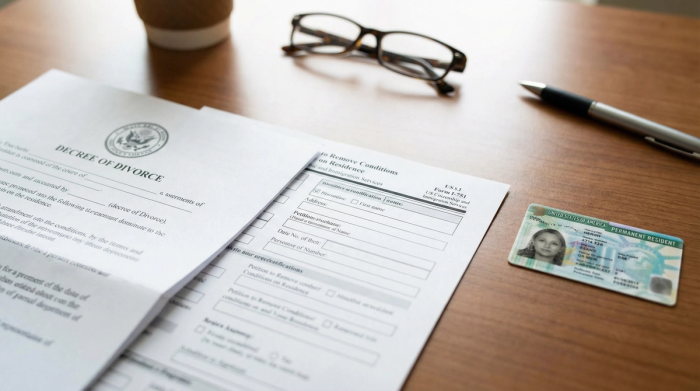
What Is the I-751 Divorce Waiver?
When you received your green card through marriage to a U.S. citizen or permanent resident, USCIS gave you conditional status that lasts two years. Normally, you'd file Form I-751 jointly with your spouse to remove those conditions. But if your marriage ends, the divorce waiver lets you file alone.
The divorce waiver exists because Congress recognized that marriages sometimes fail through no fault of the immigrant spouse. Under INA Section 216(c)(4)(B), you can request removal of conditions if your marriage was entered in good faith but has legally ended.
There are actually three types of waivers for filing I-751 without your spouse:
This guide focuses on the divorce waiver, which is the most common path for people whose marriages ended without abuse.
Important: You must prove two things for a divorce waiver: (1) your marriage has legally ended through divorce or annulment, and (2) you entered the marriage in good faith, meaning it was a real marriage and not just for immigration benefits.
Who Qualifies for the I-751 Divorce Waiver?
To file I-751 with a divorce waiver, you must meet these requirements under 8 CFR 216.5:
You currently hold conditional permanent resident status. Your green card shows a two-year expiration date, and you received it through marriage to a U.S. citizen or lawful permanent resident.
Your marriage has legally ended. You have a final divorce decree or annulment. Legal separation alone does not qualify. According to the USCIS Policy Manual, there is no basis for a waiver based on informal separation.
You entered the marriage in good faith. Your marriage was genuine at the time you got married. Even if it didn't work out, what matters is that you intended it to be a real, lasting marriage.
You do not need to prove you were "not at fault" for the terminated marriage. USCIS focuses on (1) whether your marriage legally ended (divorce or annulment), and (2) whether you entered the marriage in good faith.
One common question: Can you file if your divorce isn't final yet? Yes, but with an important caveat. You can submit your I-751 with a pending divorce, and USCIS will issue a Request for Evidence (RFE) giving you typically 87 days to provide the final decree. However, your waiver cannot be approved until the divorce is finalized. More on this timing issue below.
Divorce Waiver vs. Joint Filing: Key Differences
Understanding how the divorce waiver differs from a standard joint filing helps you prepare your case properly. For a complete overview of the standard process, see our I-751 guide to removing conditions on your green card.
The divorce waiver takes longer because USCIS applies closer scrutiny to solo filings. You'll need stronger evidence to prove your marriage was genuine since your spouse isn't there to vouch for it.
One advantage of the divorce waiver: you don't have to wait for the 90-day filing window. USCIS allows waiver requests to be filed at any time before, during, or after the 90-day period immediately preceding the second anniversary of receiving conditional residence, as soon as you are eligible for the waiver.
Step-by-Step Guide to Filing I-751 With Divorce Waiver
Here's exactly how to prepare and submit your I-751 divorce waiver petition.
Step 1: Gather Your Documents
Before touching the form, collect everything you'll need. This saves time and helps you build the strongest case possible. For divorce waivers, focus on these categories:
Required documents for every I-751 (plus additional items depending on your situation):
- Copy of your conditional green card (front and back)
- Passport-style photos (2 photos, 2x2 inches) (generally only required if filing from outside the United States due to U.S. military or government orders)
- Copy of your passport biographical page
- Evidence of your legal name if different from green card
Documents specific to divorce waiver:
- Final divorce decree or annulment (certified copy)
- If divorce is pending: filed divorce petition plus explanation
Evidence of good faith marriage (this is your most important category):
- Joint tax returns from years married
- IRS tax transcripts (more reliable than copies)
- Joint bank account statements
- Joint lease or mortgage documents
- Joint utility bills
- Insurance policies naming each other as beneficiaries
- 401(k) or retirement accounts listing spouse as beneficiary
- Birth certificates of any children together
- Photos throughout the marriage (dated if possible)
- Correspondence addressed to both of you
- Affidavits from friends and family who knew you as a couple
Pro tip: Get IRS tax transcripts instead of just copies of your returns. USCIS considers transcripts more reliable because they come directly from the IRS. Request them free at IRS.gov.
Step 2: Complete Form I-751
Download the current Form I-751 from USCIS (edition 04/01/24). For a divorce waiver, pay attention to these sections:
Part 2, Item 2: Check the box indicating you are filing for a waiver because your marriage was entered in good faith but has been terminated through divorce or annulment.
Part 3: Complete your biographical information. Use your current legal name, which may be your maiden name if you changed it back after divorce.
Part 6: This is critical. Provide a detailed explanation of your relationship, marriage, and why it ended. Be honest and thorough. Explain when you met, how your relationship developed, when you married, what your life together was like, and what led to the divorce.
Don't rush Part 6. USCIS officers read these statements carefully. A vague or minimal explanation raises red flags.
Step 3: Write a Cover Letter
While not required, a cover letter significantly helps your case. It gives USCIS a roadmap of your filing and demonstrates organization. Your cover letter should:
- State that you're filing I-751 with a divorce waiver under INA 216(c)(4)(B)
- Briefly explain your situation (married on X date, divorced on Y date, marriage was genuine)
- List every document you're including (numbered for easy reference)
- Note the total number of pages in your package
Step 4: Prepare Your Filing Package
Organize your documents in this order:
- Cover letter
- Form G-1145 (e-notification of acceptance, optional but recommended)
- Filing fee payment (G-1450 for credit/debit or G-1650 for ACH)
- Form I-751
- Copy of conditional green card
- Passport photos (only if required for your situation, such as certain filings from outside the United States due to U.S. military or government orders)
- Divorce decree
- Evidence of good faith marriage (organized by category)
Make copies of everything before mailing. Use tabs or dividers between sections.
Step 5: Pay the Filing Fee and Submit
The current I-751 filing fee is $750.
USCIS generally no longer accepts checks or money orders for paper-filed forms (without an exemption). USCIS continued accepting checks and money orders until Oct. 28, 2025; after Oct. 28, USCIS accepts only ACH debit transactions (Form G-1650) or credit card payments (Form G-1450) for paper-filed forms without an exemption. The biometrics fee is included in the I-751 filing fee. For more details on payment options, see our guide on how to pay USCIS filing fees.
Mail your package to the correct USCIS lockbox address. The address depends on where you live, so verify it before mailing. Use USPS Priority Mail or a trackable service.
Step 6: Track Your Case
After USCIS receives your package, you'll get:
- Receipt notice (I-797C): Usually within 2-4 weeks. This extends your status for 48 months beyond your card's expiration date.
- Biometrics appointment: Typically 4-8 weeks after receipt. Learn what to expect at our biometrics appointment guide.
- Decision or interview notice: This is the long wait. Many I-751 petitions take around 27-30 months in a typical case, and waiver cases can take longer depending on USCIS workload and case complexity.
Track your case online at USCIS Case Status using your receipt number.
Evidence Required to Prove Good Faith Marriage
Your evidence package is the heart of your divorce waiver case. USCIS needs to see that your marriage was real, even though it ended.
Financial Evidence
Joint finances are among the strongest proof of a genuine marriage:
- Joint bank account statements showing regular use
- Joint tax returns (all years married)
- IRS tax transcripts
- Joint credit cards
- Mortgage or loan documents with both names
- Car title or registration in both names
- Insurance policies (health, auto, life) covering both spouses
- Retirement account beneficiary designations
What if you kept finances separate? Many couples do. If you filed taxes separately or maintained individual accounts, explain why in your statement. Cultural reasons, financial circumstances, or personal preferences can all explain separate finances in a genuine marriage.
Residential Evidence
Prove you lived together as a married couple:
- Joint lease or mortgage showing both names
- Utility bills addressed to both spouses
- Mail addressed to both at the same address
- Driver's licenses showing the same address
- Voter registration at the same address
- Insurance documents showing shared residence
Life Evidence
Show your life together:
- Wedding photos and ceremony documentation
- Photos throughout the marriage (holidays, vacations, everyday life)
- Travel records showing trips together (plane tickets, hotel receipts)
- Birth certificates of children
- Cards and letters between you
- Social media posts showing your relationship
- Invitations to events as a couple
Third-Party Evidence
Statements from others who knew your marriage:
- Affidavits from friends and family (notarized statements describing your relationship)
- Greeting cards from others addressed to both of you
- Wedding guest lists and cards from attendees
For affidavits, ask people who observed your relationship firsthand. They should describe how they know you, what they observed about your marriage, and their belief that it was genuine. Each affidavit should be signed, dated, and notarized.
Important: Quality matters more than quantity. Ten pages of strong evidence beats fifty pages of weak documentation. Focus on documents that clearly show a shared life together.
What If Your Divorce Isn't Final Yet?
This is one of the most stressful situations: your conditional green card is expiring, but your divorce is still pending. Here's what you need to know.
You Can File With a Pending Divorce
USCIS allows you to submit Form I-751 even if your divorce isn't finalized. However, your case cannot be approved until the divorce is complete.
When you file with pending divorce:
- Check the divorce waiver box on Form I-751
- Include a copy of your filed divorce petition
- Explain in your statement that divorce proceedings are underway
- Include all your good faith marriage evidence
The RFE Process
USCIS will issue a Request for Evidence (RFE) asking for your final divorce decree. You typically get 87 days to respond. If your divorce finalizes within that window, send the decree and your case continues processing.
But what if your divorce takes longer than 87 days? This is where things get complicated. You should:
- Respond to the RFE before the deadline
- Explain the status of your divorce proceedings
- Provide documentation showing progress (court filings, hearing dates)
- Request additional time if needed
USCIS has discretion to extend deadlines in some cases, but don't count on it. If possible, try to coordinate your divorce timeline with your immigration case.
Converting a Joint Petition to a Waiver
If you filed I-751 jointly with your spouse but divorced while the case was pending, you can convert to a waiver. According to the USCIS Policy Manual, USCIS will issue an RFE asking you to:
- Provide your final divorce decree
- Submit a written request to amend your joint petition to a divorce waiver
- Supply any additional evidence of good faith marriage
Your original filing date is preserved, so you don't lose your place in line.
State Divorce Timing
Divorce timelines vary significantly by state. Some states have mandatory waiting periods:
If you're in a state with a long waiting period and your green card is expiring soon, consult an immigration attorney about your options. You might file with pending divorce and plan to provide the decree during the RFE window.
What to Expect After Filing
Processing Timeline
Divorce waiver cases can take longer than joint filings, and processing times vary by workload and case complexity. Many I-751 petitions take around 27-30 months in a typical case based on recent 2026 estimates. Here's the typical timeline:
These times vary by service center and individual case complexity. Check current I-751 processing times for the latest data. For broader context on USCIS delays, see our analysis of the USCIS backlog situation.
Your Receipt Notice and Status Extension
Your I-797C receipt notice is crucial. It extends your conditional resident status for 48 months beyond your green card's expiration date. This means:
- You remain a lawful permanent resident during processing
- You can work without restrictions
- You can travel internationally (with proper documentation)
- You can apply for naturalization when eligible
Carry your receipt notice with your expired green card at all times.
Biometrics Appointment
USCIS will schedule you for fingerprinting, usually at an Application Support Center near your home. This appointment takes about 30 minutes. Bring:
- Your biometrics appointment notice
- Your conditional green card
- A government-issued photo ID
If you can't make your appointment, you can request to reschedule through USCIS. For a complete walkthrough, see our biometrics appointment guide.
Request for Evidence (RFE)
Many divorce waiver cases receive RFEs asking for additional documentation. Common RFE requests include:
- Final divorce decree (if you filed with pending divorce)
- Additional evidence of good faith marriage
- Updated personal statement
- Specific documents mentioned in your application
Respond to RFEs promptly and completely. Under current rules, USCIS can deny cases without issuing an RFE, so submit strong evidence initially.
The I-751 Divorce Waiver Interview
Will You Have an Interview?
USCIS uses a risk-based approach to decide who gets interviewed. Divorce waiver cases have a higher interview likelihood than joint petitions because they receive additional scrutiny.
Factors that increase interview chances:
- Limited documentary evidence
- Short marriage duration
- Significant age difference between spouses
- Previous immigration violations
- Fraud indicators in the file
Factors that may reduce interview chances:
- Strong documentary evidence package
- Previous thorough interview at green card stage
- Long marriage duration with substantial evidence
- No fraud indicators
What USCIS Asks at Divorce Waiver Interviews
If you're scheduled for an interview, expect questions about:
Your relationship history:
- How did you meet your spouse?
- When and how did you start dating?
- Who proposed and how?
- Describe your wedding day.
Your married life:
- Where did you live together?
- How did you divide household responsibilities?
- What did you do together for fun?
- Did you meet each other's families?
The divorce:
- Why did your marriage end?
- When did problems start?
- Who initiated the divorce?
- What is your current relationship with your ex?
Evidence verification:
- Questions about specific documents you submitted
- Details about joint accounts or property
- Information from affidavits
How to Prepare
- Review all documents you submitted
- Re-read your personal statement
- Know key dates (when you met, married, separated, divorced)
- Bring originals of all documents you submitted as copies
- Dress professionally
- Answer honestly and directly
You'll attend the interview alone since you're divorced. An attorney can accompany you if desired.
Common Reasons Divorce Waivers Get Denied
Understanding denial reasons helps you build a stronger case. Common issues include:
Insufficient evidence of good faith marriage. This is the most common problem. If your evidence is thin, USCIS may conclude the marriage wasn't genuine. Solution: submit comprehensive documentation across all categories.
Failure to provide final divorce decree. Your waiver cannot be approved without proof the marriage legally ended. If divorce is pending, respond to the RFE with your final decree.
Fraud indicators. Red flags like very short marriages, no photos, completely separate finances, or inconsistent statements can doom a case. If your situation has unusual circumstances, address them honestly in your statement.
Missed deadlines. Failing to respond to RFEs or not attending biometrics appointments can result in denial. Track all deadlines carefully.
Criminal issues or inadmissibility. Certain criminal convictions or immigration violations can make you ineligible. Consult an attorney if you have any criminal history.
What If Your Ex-Spouse Won't Cooperate?
One major advantage of the divorce waiver: you don't need your ex's cooperation. You file alone, without their signature or involvement. However, gathering evidence can be harder when your ex won't help.
Getting Evidence Without Your Ex
Documents you can obtain yourself:
- Your own copies of joint tax returns (request from IRS)
- Bank statements (request from your bank for accounts you were on)
- Utility company records (if your name was on the account)
- Photos from your phone or social media
- Your own immigration file (request through FOIA)
Documents that may be harder to obtain:
- Items your ex kept after separation
- Documents only in their name
- Photos they have but you don't
Alternative evidence sources:
- Friends and family who can provide affidavits
- Wedding vendors (photographers, venue) may have records
- Social media archives
- Email records
- Church or religious institution records
Consider VAWA If Abuse Was Involved
If your marriage ended due to abuse or extreme cruelty, you may qualify for a VAWA-based waiver instead. VAWA (Violence Against Women Act) waivers offer significant benefits:
- Filing fee waived entirely
- Can include evidence of abuse instead of just good faith marriage
- Additional protections during process
- Available to all genders despite the name
VAWA waivers require different evidence, including proof of the abuse. Consult an immigration attorney or domestic violence organization if this applies to you.
After Approval: Next Steps
Once USCIS approves your I-751 divorce waiver, you'll receive:
A 10-year green card. Your new permanent resident card won't have conditions. You'll need to renew it in 10 years using Form I-90, but you won't have to prove your marriage again.
Full permanent resident status. You have all the rights of a permanent resident without conditions.
Naturalization Timeline
You can apply for U.S. citizenship through naturalization once you meet the requirements. The relevant timelines:
Since you're divorced, you'd follow the standard 5-year path, not the 3-year marriage-based path. Your time counts from when you became a conditional resident, not from when conditions were removed.
Can you apply for citizenship while I-751 is pending? Yes! You can file Form N-400 while your I-751 waiver is still processing. USCIS may adjudicate them together, or your I-751 may be approved first. For more on the naturalization process, see our complete N-400 citizenship guide.
Ready to File Your I-751 Divorce Waiver?
Immiva helps you prepare Form I-751 with step-by-step guidance, document checklists, and error checking so nothing gets missed.
Frequently Asked Questions
Yes, you can submit Form I-751 with a pending divorce. USCIS will issue a Request for Evidence giving you typically 87 days to provide the final divorce decree. Your case cannot be approved until the divorce is complete, but filing early protects your status while divorce proceedings continue. Include documentation showing your divorce is in progress.
Processing times vary by case and USCIS workload. Many I-751 petitions take around 27-30 months in a typical case based on recent 2026 estimates, and waiver cases can take longer due to additional scrutiny. Check current processing times for the latest data.
You're not required to have an attorney, and many people successfully file divorce waivers on their own. However, an immigration lawyer can be valuable if your case involves complications like criminal history, previous immigration violations, a very short marriage, or limited evidence. At minimum, consider a consultation if you're unsure about your situation.
Yes, you can travel internationally while I-751 is pending. Carry your conditional green card (even if expired), your I-797C receipt notice, and your passport. Some attorneys recommend having a copy of your tax transcripts as well. Avoid extended trips abroad that could raise questions about your residence.
Remarrying doesn't affect your I-751 divorce waiver case. The waiver is based on proving your first marriage was genuine when entered, not on your current relationship status. However, be aware that a very quick remarriage might raise questions at an interview.
If denied, you have options: file a motion to reopen (if new evidence exists), file a motion to reconsider (if USCIS made an error), or appeal to the Administrative Appeals Office. You may also be placed in removal proceedings where an immigration judge reviews your case. Consult an attorney immediately if your case is denied.
No, not all divorce waiver cases require an interview. USCIS uses a risk-based approach to determine who gets interviewed. Cases with strong evidence and no red flags may be approved without an interview. However, divorce waivers have a higher interview rate than joint filings due to the additional scrutiny these cases receive.
Short marriages can still qualify for divorce waiver approval. What matters is that the marriage was genuine when entered, not how long it lasted. Some marriages fail quickly for legitimate reasons. You'll need strong evidence that you entered the marriage in good faith, and your personal statement should explain the circumstances.
No. According to USCIS policy, legal separation alone does not qualify for the divorce waiver. You need a final divorce decree or annulment. If you're separated but still legally married, your options are: (1) wait until divorce is final to file waiver, (2) file jointly with spouse if willing, or (3) file with pending divorce if you've already started proceedings.
If you have limited joint documents, focus on what you do have and supplement with third-party evidence. Strong affidavits from friends and family who witnessed your relationship can be powerful. Photos, social media posts, travel records, and cards/letters also help. In your personal statement, honestly explain why you have limited joint documentation, whether due to cultural reasons, financial circumstances, or other factors.
Official Sources
This guide is based on current USCIS policy and federal regulations. All information was verified against these official sources as of January 2026:
USCIS Resources
- Form I-751 Official Page
- I-751 Instructions
- USCIS Policy Manual, Volume 6, Part I, Chapter 5: Waiver of Joint Filing Requirement
- USCIS Fee Schedule
- USCIS Processing Times
- I-751 Filing Addresses
Federal Regulations
- 8 CFR 216.4 - Joint Petition to Remove Conditions
- 8 CFR 216.5 - Waiver of Requirement to File Joint Petition
Immigration and Nationality Act
- INA Section 216 - Conditional Permanent Resident Status
- INA Section 216(c)(4) - Waiver Provisions
Immigration law changes frequently. We monitor USCIS policy updates and revise this guide when regulations change.
About Immiva
Simplifing Immigration Process
Resources
Contact
Disclaimer: Simple Immi LLC dba Immiva is not a lawyer or a law firm and does not engage in the practice of law, provide legal advice, or offer legal representation. The information, software, services, and comments on this site are for informational purposes only and address issues commonly encountered in immigration. They are not intended to be a substitute for professional legal advice. Immiva is not affiliated with or endorsed by the United States Citizenship and Immigration Services (USCIS) or any other government agency. Your use of this site is subject to our Terms of Use.
Copyright © 2025 immiva.com (Simple Immi LLC dba Immiva)