
Published: Jan 28, 2026|Updated: Feb 13, 2026
I-751 Processing Time 2026: Current Wait Times & What to Expect
Your conditional green card is about to expire. You're wondering how long you'll actually wait for Form I-751 approval. Here's the reality: most applicants in 2026 wait 12 to 24 months, with a median of about 21 months. But your receipt notice now extends your green card for 48 months, so you're protected while you wait.

By Michal
Filing Form I-751 to remove conditions on your green card? Learn current 2026 processing times by service center, understand the 48-month automatic extension that protects your status, and find out if you can apply for citizenship while waiting.


The wait for I-751 approval has improved from its 2024 peak, but it's still a long haul. Here's what you need to know to plan ahead and avoid surprises.
Current I-751 Processing Times in 2026
As of January 2026, USCIS reports processing times for jointly filed I-751 petitions between 10 and 23 months (USCIS Processing Times). The median sits around 20 to 21 months.
If you're filing with a waiver (because you divorced, experienced abuse, or your spouse passed away), expect longer. Waiver cases typically take 22 to 26 months due to additional scrutiny.
Processing Times by Service Center
USCIS is moving toward consolidated "Service Center Operations" (SCOPS) reporting, but processing times still vary by location:
You can't choose which service center handles your case. USCIS assigns it based on where you live and current workload distribution.
Important: Premium processing is not available for Form I-751. There's no way to pay for faster processing, regardless of your circumstances.
How Processing Times Have Changed Over Time
The I-751 backlog didn't happen overnight. Here's how we got here:

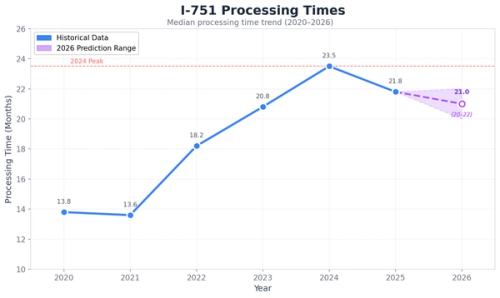
The good news: processing times peaked in 2024 and have been slowly improving since. The bad news: we're still far from the 6 to 9 month timelines that were normal a decade ago.
The 48-Month Extension: Your Safety Net
Here's the most important thing to understand: when USCIS accepts your I-751 petition, they automatically extend your conditional green card for 48 months beyond its expiration date (USCIS Alert, January 2023).
This extension started on January 25, 2023. USCIS made this change specifically because processing times had grown longer than the original 12 or 24 month extensions could cover.
What the 48-Month Extension Means for You
With your expired green card and your I-797C receipt notice together, you can:
Continue working legally. Your receipt notice satisfies Form I-9 employment verification requirements. Present your expired green card plus the receipt notice as a List C document (combined with a List B document).
Travel internationally. You can leave and re-enter the United States with your expired card and receipt notice. CBP officers are trained to recognize this combination as valid proof of status.
Apply for state IDs and driver's licenses. Most DMVs accept the receipt notice with your expired card, though policies vary by state.
Complete real estate and financial transactions. Banks and mortgage lenders increasingly recognize the 48-month extension letters.
Tip: Always carry both your expired green card AND your receipt notice when traveling or providing proof of status. The receipt notice alone is not sufficient.
What Happens After You File Form I-751
Once USCIS receives your petition, here's the typical timeline:
Step 1: Receipt Notice (2 to 4 weeks)
USCIS sends Form I-797C, Notice of Action, confirming they received your petition. This notice includes your case receipt number and the 48-month extension language.
Step 2: Biometrics Appointment (6 to 10 weeks after receipt)
You'll receive an appointment notice for fingerprinting at a local Application Support Center (ASC). This appointment usually takes less than 20 minutes.
In some cases, USCIS reuses biometrics from your original I-485 application. If so, you'll receive a "biometrics reuse" notice instead of an appointment.
Step 3: Active Review (Variable)
Your case enters the adjudication queue. During this phase, USCIS reviews your evidence to determine if your marriage is bona fide. This is where most of the waiting happens.
Step 4: Decision or Interview
USCIS either approves your petition without an interview or schedules you for one. If you've submitted strong documentation proving a genuine marriage, your interview may be waived.
If USCIS needs more information, they'll send a Request for Evidence (RFE). Responding quickly and completely to an RFE is critical since delays here extend your overall timeline.
Will You Need an I-751 Interview?
Not everyone gets called for an interview. USCIS can waive the interview requirement if your petition includes sufficient evidence of a bona fide marriage and there are no red flags (USCIS Policy Manual, Vol. 6, Part I, Ch. 2).
Factors That Increase Your Chances of an Interview Waiver
- Strong financial evidence: joint tax returns, bank accounts, and credit cards
- Shared property: joint lease, mortgage, or utility bills in both names
- Children born to the marriage (strongest evidence)
- Comprehensive photo documentation showing your life together
- Affidavits from friends and family who know your relationship
- No prior immigration violations or criminal history
Factors That May Trigger an Interview
- Large age differences between spouses
- Short courtship before marriage
- Significant income disparity
- Prior immigration denials or fraud findings
- Missing or inconsistent documentation
- Filing with a waiver (divorce, abuse, or hardship cases)
If USCIS schedules an interview, both you and your spouse must attend (unless you're filing a waiver). The interview typically lasts 15 to 30 minutes at your local USCIS field office.
Check Your Green Card Eligibility
Not sure if you qualify to remove conditions on your residence? Find out in minutes.
I-751 Filing Requirements and Fees
Current Filing Fees (January 2026)
The biometrics fee is now included in the filing fee. Previously, applicants paid a separate $85 biometrics fee (USCIS Fee Schedule).
Note: USCIS no longer accepts personal checks or money orders for paper filings. You must pay by credit card (Form G-1450) or ACH bank transfer (Form G-1650). Online filers can pay through Pay.gov.
If you're facing financial hardship, you may qualify for a fee waiver by submitting Form I-912. Fee waivers are available if you receive means-tested benefits, your household income is at or below 150% of federal poverty guidelines, or you can demonstrate extreme financial hardship.
The 90-Day Filing Window
You must file Form I-751 during the 90-day period immediately before your conditional green card expires (8 CFR § 216.4(a)(1)).
Example: If your card expires on June 15, 2026, your filing window opens on March 17, 2026.
Filing too early gets your petition rejected. Filing too late is possible but requires a written explanation and puts your status at risk.
If you're filing with a waiver (because of divorce, abuse, death of spouse, or extreme hardship), you can file at any time before your conditional status expires. You don't need to wait for the 90-day window (8 CFR § 216.5).
The Citizenship Shortcut: Filing N-400 While I-751 Is Pending
Here's something many applicants don't realize: you can apply for U.S. citizenship while your I-751 is still pending. This strategy can actually speed things up.
Who Qualifies for This Approach
If you've been married to and living with a U.S. citizen for at least 3 years, you may be eligible for naturalization under INA § 319(a). You don't need to wait for your I-751 to be approved first.
How the Combined Adjudication Works
When you file Form N-400 while your I-751 is pending, USCIS must merge both files. Because naturalization interviews happen at local field offices (not service centers), this often pulls your I-751 out of the backlog faster.
At your naturalization interview, the officer can adjudicate both your I-751 and N-400 in a single session. If everything checks out, you could walk away with both your conditions removed and your citizenship oath scheduled.
Things to Consider
This strategy works best for straightforward cases with strong marriage evidence. If your I-751 has complications (weak documentation, waiver filing, or prior RFEs), adding an N-400 might not help.
You'll also need to meet all other naturalization requirements: physical presence, continuous residence, good moral character, and ability to pass the English and civics tests.
Tip: Calculate your eligibility carefully. You can file N-400 up to 90 days before meeting the continuous residence requirement, but all requirements must be met by your interview date.
What If Your Case Is Taking Too Long?
If your I-751 is outside normal processing times, you have options.
Check Your Case Status
Use your receipt number to check status at USCIS Case Status Online. Don't panic if it says "Case Was Received" for months. That's normal.
Submit an E-Request
If your case exceeds posted processing times, submit an e-Request through the USCIS website. This alerts them that your case needs attention.
Contact Your Congressional Representative
Your U.S. Senator or Representative's office has a constituent services team that can inquire about delayed immigration cases. This doesn't guarantee faster processing, but it creates another touchpoint with USCIS.
Consider a Mandamus Lawsuit (Last Resort)
If your case has been pending for years with no movement, you may have grounds to file a federal lawsuit compelling USCIS to act. This is expensive and should only be considered after exhausting other options and consulting with an immigration attorney.
Common I-751 Mistakes to Avoid
Filing too early. USCIS will reject your petition if you file before the 90-day window opens. This wastes time and filing fees.
Insufficient evidence. Thin documentation is the top reason for RFEs and interviews. Submit comprehensive proof of your shared life: joint finances, property, insurance, photos, and third-party affidavits.
Forgetting to sign. Both you and your spouse must sign the petition for joint filings. Missing signatures mean automatic rejection.
Wrong fee amount. Check the current fee schedule before filing. USCIS rejects petitions with incorrect fees.
Filing Form I-90 instead. Don't file the green card renewal form. Your receipt notice extends your conditional card. Filing I-90 wastes $465 and doesn't help your situation.
Not responding to RFEs promptly. You typically have 87 days to respond to an RFE. Don't wait until the deadline. Submit your response as soon as possible to avoid further delays.
Preparing for U.S. Citizenship?
If you're eligible to naturalize while your I-751 is pending, we can help you prepare your N-400 application.
Frequently Asked Questions
Currently, 12 to 24 months for jointly filed petitions, with a median around 21 months. Waiver cases (divorce, abuse, hardship) typically take 22 to 26 months. Processing times vary significantly by service center.
Yes. Your receipt notice combined with your expired conditional green card serves as proof of work authorization for Form I-9 purposes. The 48-month extension covers employment eligibility.
Yes. Carry both your expired green card and your I-797C receipt notice. CBP recognizes this combination as valid for reentry. If you're planning extended travel (over 6 months), consider applying for a re-entry permit first.
That's expected. The 48-month automatic extension on your receipt notice covers this situation. Your status remains valid while your case is pending, even with an expired card.
Not necessarily. Many applicants successfully file on their own, especially for straightforward joint petitions with strong documentation. If you're filing a waiver, have a complicated immigration history, or received an RFE, consulting an attorney is worth considering.
Denial is serious. Your conditional resident status ends immediately, and USCIS typically refers your case to immigration court for removal proceedings. You'll have an opportunity to present your case before an immigration judge. If you receive a denial, consult an immigration attorney immediately.
Generally, no. USCIS rarely grants expedite requests for I-751 petitions. Expedite criteria include severe financial loss, emergencies, humanitarian reasons, or USCIS error. Most routine cases don't qualify.
A Request for Evidence (RFE) means USCIS needs more documentation before deciding your case. This isn't a denial. Respond completely and promptly with the specific evidence requested. Organize your response clearly and include a cover letter referencing your receipt number.
Maybe not. USCIS waives interviews for many joint petitions with strong evidence. Waiver cases and petitions with documentation gaps are more likely to require interviews.
Yes, but you'll need to request a waiver of the joint filing requirement under 8 CFR § 216.5. You must prove the marriage was entered in good faith even though it ended. Divorce waiver cases undergo closer scrutiny and typically take longer.
Form I-751 removes conditions from a 2-year conditional green card, converting it to a 10-year permanent resident card. Form I-90 renews an already-expired 10-year green card. These are completely different processes. Don't file I-90 if you have a conditional card.
"Case Was Received" can show for over a year while your petition waits in the adjudication queue. Status typically only updates when there's a change: biometrics scheduled, RFE issued, interview scheduled, or decision made.
If your spouse won't sign the joint petition, you may be able to file with a waiver. Grounds include divorce, death of spouse, battery or extreme cruelty, or extreme hardship from removal. Document your situation thoroughly.
Official Sources
This guide is based on current USCIS policy and federal regulations. All information was verified against these official sources as of January 2026:
USCIS Resources
- Form I-751 Official Page
- Form I-751 Instructions
- USCIS Policy Manual, Volume 6, Part I: Conditional Permanent Residence
- USCIS Fee Schedule (Form G-1055)
- USCIS Processing Times
- 48-Month Extension Announcement
Federal Regulations
- 8 CFR Part 216 - Conditional basis of lawful permanent residence
- 8 CFR § 216.4 - Joint petition to remove conditional basis
- 8 CFR § 216.5 - Waiver of joint filing requirement
Immigration and Nationality Act
- INA § 216 (8 U.S.C. 1186a) - Conditional permanent resident status for certain alien spouses and sons and daughters
Immigration law changes frequently. We monitor USCIS policy updates and revise this guide when regulations change.
About Immiva
Simplifing Immigration Process
Resources
Contact
Disclaimer: Simple Immi LLC dba Immiva is not a lawyer or a law firm and does not engage in the practice of law, provide legal advice, or offer legal representation. The information, software, services, and comments on this site are for informational purposes only and address issues commonly encountered in immigration. They are not intended to be a substitute for professional legal advice. Immiva is not affiliated with or endorsed by the United States Citizenship and Immigration Services (USCIS) or any other government agency. Your use of this site is subject to our Terms of Use.
Copyright © 2025 immiva.com (Simple Immi LLC dba Immiva)