
Published: Feb 06, 2026|Updated: Feb 20, 2026
Citizenship Through Marriage: 3-Year Rule Guide (2026)
Married to a U.S. citizen? You may apply for citizenship 2 years earlier. Here is how the 3-year rule works.

By Michal
You have been a permanent resident, you have built a life with your U.S. citizen spouse, and now you are ready to become a citizen yourself. The good news is you may not need to wait the standard 5 years.

What Is the 3-Year Citizenship Rule?
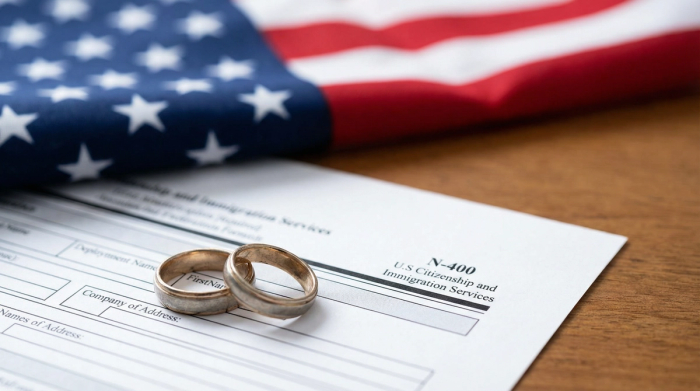
The 3-year rule is a special provision under INA Section 319(a) that allows certain spouses of U.S. citizens to naturalize after 3 years as a permanent resident instead of the usual 5 years. This isn't automatic, though. You must meet specific requirements related to your marriage, your spouse's citizenship status, and how you've lived together during this period.
Congress created this faster path for spouses who get their green cards through marriage to a U.S. citizen. USCIS takes these applications seriously, and the requirements are strict.
Key distinction: Marrying a U.S. citizen doesn't automatically make you a citizen. You must first get a green card, then apply for naturalization after meeting the residence requirements.
Who Qualifies for the 3-Year Path?
To apply under the 3-year rule, you must meet all of these requirements at the time you file your N-400 and continue to meet them through your oath ceremony (8 CFR § 319.1):
The 11 Requirements for Marriage-Based Naturalization
- Be at least 18 years old at the time of filing
- Have been a lawful permanent resident for at least 3 years (your "Resident Since" date on your green card determines this, not the card issue date)
- Be currently married to and living with the same U.S. citizen spouse you've been married to for all 3 years immediately preceding your filing
- Your spouse must have been a U.S. citizen for the entire 3 years before your filing date. If your spouse naturalized recently, your 3-year clock starts from their naturalization date, not your green card date.
- Live in "marital union" with your spouse for the 3 years immediately preceding your filing date. This means living together as a married couple during that period. Brief separations for work or travel don't break this, but living apart for extended periods can. After filing, you must remain legally married through the oath ceremony, though the "marital union" standard itself applies only to the pre-filing period.
- Meet the physical presence requirement: At least 548 days (18 months) physically in the United States during the 3-year period (USCIS Policy Manual, Vol. 12, Part D, Ch. 4)
- Meet continuous residence requirements: No single trip abroad lasting 1 year or more (which automatically breaks residence), and trips of 6-12 months create a rebuttable presumption you must overcome with evidence of maintained U.S. ties (USCIS Policy Manual, Vol. 12, Part D, Ch. 3)
- Live in the state or USCIS district where you file for at least 3 months before filing
- Demonstrate good moral character for the 3-year statutory period. This is now evaluated under a stricter "totality of circumstances" standard as of August 2025 (USCIS Policy Manual, Vol. 12, Part F)
- Pass the English reading, writing, and speaking test during your interview
- Pass the 2025 civics test (12 correct out of 20 questions from the new 128-question pool)
If you're unsure whether you meet these requirements, use our free N-400 eligibility checker to calculate your eligibility date and physical presence automatically.
Check If You Qualify for the 3-Year Path
Our free eligibility checker calculates your filing date, physical presence days, and continuous residence automatically.
2025-2026 Policy Changes Affecting Marriage-Based Applicants
If you're applying in 2026, policy changes from 2025 affect your application.
New Civics Test (October 2025)
The citizenship test changed significantly. If you file on or after October 20, 2025, you'll take the new 2025 version:
This is a harder test that requires more preparation. Start studying early with our 128 civics questions study guide.
Stricter Good Moral Character Standard (August 2025)
USCIS now evaluates your character using a "totality of circumstances" approach rather than a simple checklist. Officers look at the whole picture, including positive factors like:
- Stable employment and tax compliance
- Community involvement and volunteer work
- Family responsibilities and caregiving
- Educational achievements
- Character references from neighbors and colleagues
A clean record alone may no longer be sufficient. If you have any concerns about past issues, consult an immigration attorney or read our guide on citizenship with a DUI if that applies to you.
Neighborhood Investigations (November 2025)
For the first time since 1991, USCIS may contact your neighbors, employers, or coworkers as part of your application review. This doesn't happen in every case, but you should be prepared. Consider gathering character reference letters proactively.
Check If You Qualify for the 3-Year Path Our free eligibility checker calculates your earliest filing date, physical presence days, and confirms you meet all 11 requirements. Check Your Eligibility
Calculating Your Eligibility Date
You can file your N-400 up to 90 days before you meet the 3-year continuous residence requirement (8 CFR § 334.2(b)). To calculate your earliest filing date:
Example: Your green card shows "Resident Since: March 15, 2023"
- 3 years from March 15, 2023 = March 15, 2026
- 90 days early = December 15, 2025
- Earliest filing date: December 15, 2025
Common Timing Mistakes
Mistake 1: Counting from your wedding anniversary instead of your green card date. The 3 years is measured from when you became a permanent resident, not from when you got married.
Mistake 2: Filing before your spouse has been a citizen for 3 years. If your spouse naturalized on June 1, 2023, you cannot file under the 3-year rule until June 1, 2026 (or 90 days early on March 3, 2026), regardless of how long you've held your green card.
Mistake 3: Not accounting for time as a conditional resident. If you received a 2-year conditional green card through marriage and then filed I-751 to remove conditions, your time as a conditional resident counts toward your 3 years. Use our free eligibility checker to avoid these calculation errors.
Physical Presence vs. Continuous Residence
These are two separate requirements that confuse many applicants:
Physical Presence (548 days): This counts the actual number of days you were physically in the United States during the 3-year period. Every day outside the U.S. counts against you. You need at least 548 days (18 months) inside the country.
Continuous Residence (unbroken residency): For more details on how USCIS evaluates this, see our continuous residence guide.
For a detailed breakdown of how to calculate your days and handle long trips, see our physical presence requirements guide.
What Is "Living in Marital Union"?
"Living in marital union" means more than just being legally married. You must actually live together as a married couple. USCIS interprets this strictly (USCIS Policy Manual, Vol. 12, Part G, Ch. 3).
What Counts as Living in Marital Union
- Living at the same address as your spouse
- Brief separations for work travel or family emergencies
- Temporary absences where you maintain one shared household
- Situations where one spouse is deployed with the military
What May Break Marital Union
- Living at separate addresses for extended periods (even within the same city)
- Formal or informal separation agreements
- One spouse maintaining a separate residence in another state
- Extended separations without clear documentation of ongoing marriage
USCIS may ask for proof of marital union at your interview. Be prepared to show joint tax returns, shared bank accounts, joint lease or mortgage, utility bills in both names, insurance policies listing each other, and photos of you together over the 3-year period.
Can I Apply While My I-751 Is Pending?
Yes. If you received a 2-year conditional green card through marriage and filed your I-751 to remove conditions, you can file N-400 once you've met the 3-year residence requirement, even if your I-751 hasn't been decided yet.
How it works:
- Your N-400 and I-751 may be processed together at a "combo interview"
- Your N-400 cannot be approved until your I-751 is approved
- But filing early means USCIS adjudicates both simultaneously, which can reduce your total wait time
Current I-751 processing times range from 12-33 months depending on your service center and case complexity, so filing your N-400 as early as possible makes sense. The cases will move through the system together.
Important: If your I-751 is denied, your N-400 will also be denied. Make sure your I-751 application is strong.
The Interview: Marriage-Specific Questions
Your citizenship interview will include questions about your marriage to verify you qualify for the 3-year path. Be prepared to answer:
- When and where did you get married?
- How did you and your spouse meet?
- Where do you currently live together?
- Does your spouse work? Where?
- What are your spouse's daily habits and routines?
- Have you ever been separated from your spouse?
- Have you filed joint tax returns?
These questions aren't meant to trick you. They verify that you're actually living as a married couple. Answer honestly and directly. If you're nervous about your interview, our complete N-400 guide walks through the entire process from filing to oath.
Ready to Apply for Citizenship? Immiva guides you through every N-400 question, flags potential issues, and prepares your complete filing package. No lawyer needed. Start Your Application
What Happens If You Divorce Before the Oath Ceremony?
You must remain married through your naturalization oath ceremony to qualify under the 3-year rule. If you divorce at any point before taking the oath, you lose eligibility for the 3-year path.
What happens in different scenarios:
Divorce while N-400 is pending: Your application under the 3-year rule will be denied. However, if you've been a permanent resident for 5 years by the time of your interview, you may be able to continue under the standard 5-year rule without refiling.
Separation but not divorced: You may still qualify if you can demonstrate you're still legally married and living in marital union. However, a formal separation or living apart makes this difficult to prove.
Spouse passes away before oath: This is treated differently from divorce. If your citizen spouse passes away after you file but before your oath, you may still be eligible under INA § 319(a) provided you were in marital union at the time of death and do not remarry. If your spouse dies before you file, the analysis is more complex—consult an immigration attorney for guidance.
If your marriage situation is complicated, consider consulting an immigration attorney before filing.
Documents You'll Need
For your N-400 application and interview, gather these documents:
Standard Documents
- Green card (front and back)
- Valid passport
- Driver's license or state ID
- Travel records for the past 3 years (passport stamps, boarding passes)
- Tax returns for the past 3 years
- Any court records if applicable
Marriage-Specific Documents (3-Year Path)
- Marriage certificate
- Spouse's U.S. citizenship proof (passport, naturalization certificate, or birth certificate)
- Joint tax returns
- Joint bank account statements
- Lease or mortgage showing both names
- Utility bills showing shared address
- Insurance policies listing each other
- Photos of you together spanning the 3-year period
For the complete checklist, see our N-400 document preparation guide.
Current Filing Fees (2026)
Since October 28, 2025, USCIS no longer accepts checks or money orders. You must pay electronically. Online filing saves $50 and typically processes faster.
For more details on costs and ways to save, read our N-400 costs guide.
Processing Times
As of January 2026, national median processing time for N-400 applications is approximately 5.5 months from filing to oath ceremony, making this the fastest processing period since 2016 (USCIS Processing Times).
Processing varies significantly by field office:
- Fastest: Cincinnati, OH (approximately 2.5 months)
- Slowest: Harlingen, TX (approximately 18 months)
Your biometrics appointment typically occurs 4-6 weeks after filing, and your interview is scheduled based on your local office's workload.
Start Your N-400 Application With Immiva
We guide you through every question on the citizenship application, help you gather the right documents, and file on your behalf.
Frequently Asked Questions
You don't become a citizen just by being married. You need to: (1) get a green card through your marriage, (2) be married to and living with your U.S. citizen spouse for at least 3 years, and (3) meet all other naturalization requirements. The earliest you can file is 2 years and 9 months after becoming a permanent resident (90 days early filing). Use our eligibility checker to find your exact date.
No, your spouse is not required to attend. However, bring documents proving your marriage is genuine and ongoing. USCIS may ask questions about your spouse and married life. If your marriage is recent or your circumstances are complex, having your spouse attend can help.
Your 3-year clock starts from when your spouse became a citizen, not when you got your green card. If your spouse naturalized after you became a permanent resident, count 3 years from their naturalization date. You must also have been married to them for that entire period.
Yes, separate bank accounts alone don't disqualify you. What matters is proving you live together as a married couple. If you have separate finances, be prepared to explain why and provide other evidence of your shared life, such as a joint lease, shared address on tax returns, and photos together.
Business travel doesn't automatically disqualify you. Focus on two things: (1) maintaining enough physical presence days (548 minimum), and (2) keeping any single trip under 6 months (trips of 6-12 months create a rebuttable presumption you can overcome with evidence; trips over 1 year break residence automatically). Keep detailed records of your travel. If your job requires extended international assignments, consult an immigration attorney before filing.
Yes. Time as a conditional resident (2-year green card) counts toward your 3-year continuous residence requirement. If you've held a conditional green card for 2 years and are in the process of filing I-751 to remove conditions, that time still counts.
USCIS may schedule a combined interview to adjudicate both applications at once. Your citizenship cannot be approved until your I-751 is approved, but processing them together is efficient. Make sure both applications are accurate and consistent.
Yes. Since the Supreme Court's decision in Obergefell v. Hodges (2015), same-sex marriages are recognized equally for all immigration purposes, including the 3-year naturalization path.
Next Steps
If you're married to a U.S. citizen and ready to become a citizen yourself:
- Confirm your eligibility with our free N-400 eligibility checker. It calculates your earliest filing date and physical presence.
- Gather your documents using the checklist above, paying special attention to marriage-specific evidence.
- Start studying for the civics test with our 128-question study guide.
- File your application when eligible. Start your N-400 with Immiva for step-by-step guidance through every question.
For the complete citizenship process from start to finish, see our N-400 guide: how to apply for U.S. citizenship step by step.
Official Sources
This guide is based on current USCIS policy and federal regulations. All information was verified against these official sources as of February 2026:
USCIS Resources
- Form N-400 Official Page
- Form N-400 Instructions
- USCIS Policy Manual, Volume 12, Part G, Chapter 3 (Spouses of U.S. Citizens)
- USCIS "I Am Married to a U.S. Citizen" Page
- USCIS Fee Schedule
- USCIS Processing Times Tool
- USCIS Early Filing Calculator
- 2025 Civics Test Resources
Federal Regulations
- 8 CFR § 319.1 — Naturalization for spouses of U.S. citizens
- 8 CFR § 334.2(b) — 90-day early filing
- 8 CFR § 316.5 — Continuous residence requirements
Immigration and Nationality Act
- INA § 319(a) / 8 USC 1430 — Spouse of U.S. citizen naturalization
- INA § 312(a) — English and civics requirements
Immigration law changes frequently. We monitor USCIS policy updates and revise this guide when regulations change.
About Immiva
Simplifing Immigration Process
Resources
Contact
Disclaimer: Simple Immi LLC dba Immiva is not a lawyer or a law firm and does not engage in the practice of law, provide legal advice, or offer legal representation. The information, software, services, and comments on this site are for informational purposes only and address issues commonly encountered in immigration. They are not intended to be a substitute for professional legal advice. Immiva is not affiliated with or endorsed by the United States Citizenship and Immigration Services (USCIS) or any other government agency. Your use of this site is subject to our Terms of Use.
Copyright © 2025 immiva.com (Simple Immi LLC dba Immiva)