
Published: Feb 07, 2026
Citizenship Requirements 2026: Complete Eligibility Guide
Wondering if you're eligible for U.S. citizenship? Here's what naturalization requires and the major changes you need to know for 2026.

By Michal
This guide covers every requirement you need to meet for U.S. citizenship in 2026, including the new civics test, stricter good moral character standards, and how to position yourself for approval.

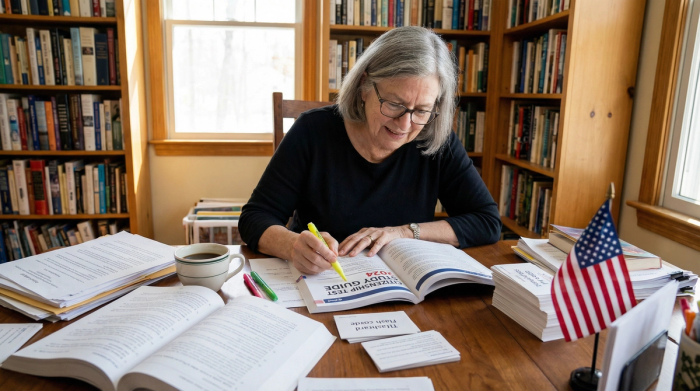
What Changed for Citizenship in 2025-2026
If you're applying for citizenship in 2026, three major policy changes will affect your application.
October 2025: The New Civics Test
USCIS implemented a significantly harder civics test for new N-400 filers. The 2025 Naturalization Civics Test reimplements the 2020 civics test with modifications. It has 128 questions instead of 100, asks 20 questions during your interview instead of 10, and requires 12 correct answers to pass instead of 6 (USCIS 2025 Civics Test). Which test you take depends on your filing date. If you filed before October 20, 2025, you take the easier 2008 test. Filing on or after that date means you take the 2025 version.
Download our 128 civics questions study guide covering all the new material.
August 2025: Stricter Good Moral Character Evaluation
USCIS evaluates good moral character using the standards in the USCIS Policy Manual (Vol. 12, Part F). A clean criminal record alone may not be sufficient, because USCIS can consider the totality of the circumstances and the applicant's conduct during the statutory period. Officers also review issues such as false claims to U.S. citizenship and unlawful voting, which can affect eligibility.
For a detailed breakdown of what could disqualify you, see our guide on good moral character for N-400.
August 2025: Neighborhood Investigations Resumed
USCIS has also stepped up how it verifies applicants. On August 22, 2025, USCIS issued a policy memorandum (PM-602-0189) announcing it is resuming personal ("neighborhood") investigations of naturalization applicants under INA § 335(a). Check with your local field office to see how this affects your case.
The 10 Requirements for U.S. Citizenship
To naturalize as a U.S. citizen, you must meet every one of these requirements under the INA (primarily INA § 316, with testing requirements under INA § 312):
1. Be at Least 18 Years Old
You must be 18 or older at the time you file Form N-400. There's no upper age limit. Seniors can qualify for age-based exemptions on the English and civics tests.
2. Be a Lawful Permanent Resident
You must hold a valid green card. Most applicants need 5 years as a permanent resident. Spouses of U.S. citizens may qualify after just 3 years if they meet additional requirements (INA § 319).
Not sure when your time started? Your eligibility begins from the "Resident Since" date on your green card, which may differ from the date the card was issued.
Important: Your lawful permanent resident (LPR) status does not expire when your green card expires, but you must have valid, unexpired proof of LPR status in your possession at all times. If you file Form N-400, USCIS may automatically extend the validity of your green card for 24 months from the "Card Expires" date through the N-400 receipt notice.
3. Meet Continuous Residence Requirements
You must have lived continuously in the United States for the required period (5 years or 3 years for spouses of U.S. citizens) immediately before filing (8 CFR § 316.5).
What breaks continuous residence:
- Any single trip of more than 6 months (more than 180 days) but less than 1 year may disrupt your continuous residence and is presumed to break the continuity of your residence unless you can prove otherwise.
- Any trip of 1 year or more automatically breaks your continuous residence
- Frequent short trips can also raise red flags if the pattern suggests you're not really living in the U.S.
If you have a long trip planned, you may need Form N-470 to preserve your residence. For detailed rules, see our continuous residence requirements guide.
4. Meet Physical Presence Requirements
You must have been physically present in the United States for at least half of your required residence period (USCIS Policy Manual, Vol. 12, Part D, Ch. 4):
Every day outside the U.S. counts against you. Use our free N-400 eligibility checker to calculate your physical presence automatically based on your travel history.
For more on calculating your days, read our physical presence requirements guide.
5. Live in Your State or District for 3 Months
You must have resided in the state or USCIS district where you're applying for at least 3 months before filing (8 CFR § 316.2(a)(5)). If you recently moved states, wait until you've established 3 months of residency before filing.
6. Demonstrate Good Moral Character
You must show good moral character for the entire statutory period before filing—5 years for most applicants, 3 years for spouses of U.S. citizens (INA § 316(a)(3)).
Under the August 2025 policy changes, USCIS now evaluates good moral character (GMC) using a more holistic approach that accounts for an applicant's positive attributes, not only the absence of misconduct. Examples of factors that may support a positive finding include:
- Community volunteer work and civic engagement
- Stable employment history
- Family caregiving responsibilities
- Educational achievements
- Complete tax compliance (filing returns AND paying all amounts owed)
- Testimonial letters from neighbors, employers, or community members
Factors that can bar you from citizenship include:
- Permanent bars: Murder, aggravated felony, persecution of others
- Conditional bars: Controlled substance violations (except simple possession of 30g or less of marijuana), two or more gambling offenses, imprisonment for 180+ days, false claims to U.S. citizenship, unlawful voting
Under the new standard, even issues like a bounced check or missed tax filing can matter. If you have concerns about your record, read our guide on DUI and citizenship or consult an immigration attorney.
7. Speak, Read, and Write Basic English
You must demonstrate the ability to read, write, and speak basic English (INA § 312(a)). During your interview, the officer will test you by:
- Having you read 1 of 3 sentences aloud
- Having you write 1 of 3 sentences dictated to you
- Conducting the interview in English and evaluating your comprehension
Exemptions from the English test:
If you have a medical condition preventing you from taking the test, you may qualify for an exemption with Form N-648.
8. Pass the Civics Test
You must demonstrate knowledge of U.S. history and government (INA § 312(a)).
2025 Civics Test vs. 2008 Test:
65/20 Exception: Applicants aged 65 or older with 20+ years as a permanent resident take a simplified version—10 questions from a 20-question bank, with 6 correct to pass.
If you fail, you get one more chance at your rescheduled interview. For study resources, see our 128 civics questions study guide.
9. Be Attached to the Principles of the Constitution
You must show attachment to the principles of the U.S. Constitution and be well-disposed to the good order and happiness of the United States. This is evaluated through your application answers, interview, and the Oath of Allegiance you'll take at naturalization.
10. Take the Oath of Allegiance
After passing your interview and tests, you must attend a naturalization ceremony and take the Oath of Allegiance. You're not a citizen until you complete this oath—approval at your interview is not the final step.
Note: Some religious or conscientious objections can qualify for modified oath language. Talk to USCIS if this applies to you.
Check If You Qualify for Citizenship Not sure if you meet all the requirements? Our free eligibility checker analyzes your green card time, travel history, and more in minutes. Check Your Eligibility
Special Eligibility Categories
Not everyone follows the standard 5-year path. Some applicants qualify through faster or alternative routes:
Spouses of U.S. Citizens (3-Year Path)
You may qualify after just 3 years as a permanent resident if you:
- Have been married to and living with your U.S. citizen spouse for all 3 years
- Your spouse has been a citizen for all 3 years
- Meet 18 months of physical presence (instead of 30)
- Meet all other requirements
The marriage must be genuine and ongoing. If you divorce before naturalization, you lose eligibility for the 3-year path and must wait for 5 years total. Learn more in our citizenship through marriage guide.
Military Service Members
Active duty and veteran service members have expedited paths under INA § 328 (peacetime) and INA § 329 (hostilities period):
- No filing fee required
- Reduced or eliminated residence and physical presence requirements
- Overseas naturalization available at U.S. embassies or military bases
Children of U.S. Citizens
Children under 18 may acquire citizenship automatically when their parent naturalizes, if they're living in the U.S. as permanent residents in the parent's custody (INA § 320). You don't file N-400 for this—apply for a Certificate of Citizenship with Form N-600 instead.
Check Your N-400 Eligibility
Not sure which path to citizenship applies to you? Our free eligibility checker analyzes your green card timeline, physical presence, and travel history in minutes.
Current Costs and Processing Times
N-400 Filing Fees (2026)
Online filing saves $50. As of Oct. 28, 2025, USCIS generally no longer accepts paper checks or money orders for paper-filed forms—payment must be made by credit card (Form G-1450) or ACH debit (Form G-1650), unless an exemption applies. If you qualify for a fee waiver, see our N-400 fee waiver guide.
For a complete breakdown, read our guide on N-400 costs explained.
Processing Times
USCIS processing times vary widely by field office and can change over time. Check the USCIS Processing Times Tool for current estimates for your location (USCIS Processing Times).
For detailed processing data, see our N-400 processing times guide.
Can You File 90 Days Early?
Yes. You can submit your N-400 up to 90 days before you meet the continuous residence requirement (8 CFR § 334.2(b)). This means:
- 5-year path: File at 4 years, 9 months as a permanent resident
- 3-year spouse path: File at 2 years, 9 months as a permanent resident
USCIS will schedule your interview after you actually reach the 5-year or 3-year mark. Early filing can shave months off your total wait time.
Ready to Apply for Citizenship? Immiva walks you through the N-400 application step by step—no lawyer needed. We check your answers, flag potential issues, and prepare your complete filing package. Start Your Application
Common Mistakes That Delay Citizenship
These errors can slow your application or lead to denial. Avoid them:
Filing before you're eligible. USCIS will deny premature applications. Use our eligibility checker to confirm your dates.
Miscounting physical presence. Every day outside the U.S. counts against you. Keep detailed travel records.
Not disclosing arrests. You must report all arrests, even if charges were dropped, dismissed, or expunged. USCIS accesses FBI records and will find them.
Tax issues. Under August 2025 policy, USCIS may scrutinize tax compliance more closely. If taxes are owed, USCIS instructions allow you to submit a signed agreement from the IRS (or state/local tax authority) showing you filed and have arranged to pay the taxes you owe.
Missing your interview. Missing an appointment without rescheduling can result in denial. If you need to reschedule, see our guide on rescheduling USCIS appointments.
For a complete list, read our N-400 mistakes that get applications denied.
Frequently Asked Questions
Most applicants must wait 5 years as a permanent resident. Spouses of U.S. citizens living with their spouse may qualify after 3 years. You can file up to 90 days before reaching these milestones. Use our N-400 eligibility checker to calculate your exact eligibility date.
It depends on the offense. Minor infractions like traffic tickets usually don't affect your application. DUIs, drug offenses, and crimes involving moral turpitude require careful evaluation. Aggravated felonies and murder permanently bar citizenship. Consult our guide on citizenship with a criminal record or speak with an immigration attorney.
You get a second chance. USCIS will reschedule your interview within 60-90 days for another attempt at the portions you failed. If you fail twice, your application is denied, but you can reapply with a new N-400 and fee. See our guide on what to do if you fail the citizenship test.
Yes, but be careful. Trips under 6 months generally don't cause problems. Trips of 6 months or more can break your continuous residence and make you ineligible—even if you were eligible when you filed. You also risk missing interview appointments. Read our travel while N-400 is pending guide before booking any trips.
No. Many applicants successfully file without legal help, especially if they have straightforward cases with no criminal history, tax issues, or complex travel patterns. Immiva can help you file without a lawyer at a fraction of the cost of traditional legal services.
The standard N-400 filing fee is $710 for online applications or $760 for paper. If your income is between 150-400% of Federal Poverty Guidelines, you may qualify for a reduced $380 fee. If you're at or below 150% FPG, you may qualify for a complete fee waiver.
This is the date USCIS considers you a permanent resident, which may be earlier than the date your green card was issued. For refugees and asylees, it's often backdated one year from the date of status adjustment. This is the date used to calculate your 5-year or 3-year eligibility.
Yes. If your I-751 to remove conditions on your green card is pending, you can file N-400 once you've met the residence requirement. USCIS may process them together or sequentially. Your N-400 cannot be approved until your I-751 is resolved, but filing early can reduce your overall wait time. See our guide on N-400 while I-751 is pending.
Essential documents include your green card, passport, state ID, travel records for the past 5 years, tax returns for the past 5 years, and any court records if applicable. For a complete checklist, see our N-400 document checklist guide.
Not directly. You must first become a lawful permanent resident (green card holder) and meet the residence and physical presence requirements before applying for naturalization. There are limited paths to a green card for undocumented individuals, including marriage to a U.S. citizen, VAWA protections, or special immigration categories.
Next Steps
Ready to apply? Here's what to do:
- Confirm your eligibility. Use our free N-400 eligibility checker to verify you meet all requirements.
- Gather your documents. Review our N-400 document checklist and start collecting everything you'll need.
- Study for the civics test. Download our 128 civics questions study guide and start preparing early.
- File your application. Start your N-400 with Immiva to get step-by-step guidance through every question.
For a complete walkthrough of the entire process from start to oath, see our N-400 guide: how to apply for citizenship step by step.
Official Sources
This guide is based on current USCIS policy and federal regulations. All information was verified against these official sources as of January 2026:
USCIS Resources
- USCIS Naturalization Eligibility Overview
- Form N-400 Official Page
- Form N-400 Instructions
- USCIS Policy Manual, Volume 12 (Citizenship & Naturalization)
- USCIS Fee Schedule
- USCIS Processing Times Tool
- 2025 Civics Test Resources
- 128 Civics Questions and Answers (PDF)
Policy Documents (2025)
- Good Moral Character Policy Memo (PM-602-0188) — August 15, 2025
- Neighborhood Investigations Policy (PM-602-0189) — August 22, 2025
- 2025 Civics Test Implementation Notice — September 18, 2025
Federal Regulations
- 8 CFR § 316 — General naturalization requirements
- 8 CFR § 316.5 — Residence in the United States
- 8 CFR § 316.10 — Good moral character
- 8 CFR § 312 — English and civics test requirements
- 8 CFR § 319 — Spouse of U.S. citizen naturalization
Immigration and Nationality Act
- INA § 312 — Language and civics requirements
- INA § 316 — General requirements for naturalization
- INA § 319 — Naturalization for spouses of U.S. citizens
- INA § 320 — Acquisition of citizenship for children
Immigration law changes frequently. We update this guide when USCIS publishes new policy or regulatory changes.
About Immiva
Simplifing Immigration Process
Resources
Contact
Disclaimer: Simple Immi LLC dba Immiva is not a lawyer or a law firm and does not engage in the practice of law, provide legal advice, or offer legal representation. The information, software, services, and comments on this site are for informational purposes only and address issues commonly encountered in immigration. They are not intended to be a substitute for professional legal advice. Immiva is not affiliated with or endorsed by the United States Citizenship and Immigration Services (USCIS) or any other government agency. Your use of this site is subject to our Terms of Use.
Copyright © 2025 immiva.com (Simple Immi LLC dba Immiva)