
Published: Feb 05, 2026
What to Bring to Your Citizenship Interview: Complete List
Your interview is scheduled. Here's exactly what to bring, how to organize it, and what could trip you up on the day that matters most.

By Alicja
Complete list of documents for your N-400 citizenship interview including situation-specific checklists, 2025 policy changes, and what NOT to bring.

Your citizenship interview is the final hurdle before becoming a U.S. citizen. Walking in without the right documents can mean rescheduling, delays, or worse. This guide covers exactly what you need to bring based on your situation, what to leave at home, and how to organize everything so your interview goes smoothly.
The 6 Documents Every Applicant Must Bring
Regardless of your situation, you need these six items at every naturalization interview. Missing even one can cause problems.
1. Interview Appointment Notice (Form I-797C)
This is your ticket in the door. The notice shows your interview date, time, and the exact USCIS field office address. Bring the original. If you lost it, check your myUSCIS account to download a copy, or call the USCIS Contact Center at 1-800-375-5283.
2. Permanent Resident Card (Green Card)
Bring your green card even if it's expired. Your lawful permanent resident status doesn't expire when your card does (USCIS Policy Manual, Vol. 12, Part B, Ch. 2). USCIS needs to verify your A-Number and photograph. If your card is lost or stolen, you can still attend with your I-797C receipt notice from your N-400 filing, which extends card validity for 24 months.
Important: You won't surrender your green card at the interview. That happens later at your oath ceremony.
3. State-Issued Photo ID
This can be your driver's license, state ID card, or valid passport. It must show your current legal name. If your name changed after your green card was issued, bring documentation of the name change (marriage certificate, divorce decree, or court order).
4. All Passports (Current and Expired)
Bring every passport you've held since becoming a permanent resident, including expired ones. USCIS uses these to verify your travel history and continuous residence. If you've lost an old passport, you can request your I-94 travel history from CBP to help reconstruct your trips.
5. Travel Documents (If Applicable)
If you've used any USCIS-issued travel documents, bring them:
- Reentry Permit (Form I-131)
- Advance Parole document
- Refugee Travel Document
6. Originals of All Documents Submitted With Your N-400
Per 8 CFR § 316.4, officers may request original documents to verify authenticity during your interview. This includes birth certificates, marriage certificates, tax transcripts, and any court records you submitted as copies with your application.
If you used Immiva to file your N-400, you can log in to review exactly which documents you submitted. Use our free N-400 eligibility checker to confirm you met all requirements before your interview.
Additional Documents Based on Your Situation
Your specific circumstances determine what else you need. Find your situation below and add those documents to your checklist.
If You're Applying Through Marriage to a U.S. Citizen (3-Year Rule)
Applicants using the 3-year marriage-based pathway must prove their spouse has been a U.S. citizen for at least 3 years and that you've lived in "marital union" together.
Required documents:
- Your spouse's U.S. citizenship proof (birth certificate, naturalization certificate, or U.S. passport)
- Your marriage certificate (original or certified copy)
- Evidence of living together: joint lease or property deed, utility bills in both names, joint bank statements, shared insurance policies
- If either spouse was previously married: divorce decrees or death certificates for ALL prior marriages
- Joint tax returns from the last 3 years (transcripts from IRS are acceptable)
If your marriage has faced challenges or you're separated, talk to an immigration attorney before your interview. The officer will ask questions about your relationship.
If You Have Any Arrest or Criminal History
You must bring certified court dispositions for every arrest, even if charges were dismissed, expunged, or you were found not guilty (USCIS Policy Manual, Vol. 12, Part F, Ch. 2). USCIS considers your complete record when evaluating good moral character.
Required documents:
- Certified court disposition for EACH arrest (obtain from the court where your case was heard)
- Sentencing records for any conviction
- Probation or parole completion letters
- Evidence of rehabilitation (completion of classes, community service, letters from employers)
If you had a DUI or alcohol-related offense, bring court records showing completion of any required treatment programs.
Note: Traffic tickets generally don't need documentation unless they involved alcohol, drugs, an arrest, or serious injury. When in doubt, bring the records.
If You're a Male Who Was Required to Register for Selective Service
Men who were in the U.S. between ages 18-26 must show Selective Service compliance.
If you're 18-25: You should already be registered. Bring your Selective Service registration card or verify your registration online.
If you're 26-31 and didn't register: Request a Status Information Letter from Selective Service. Also prepare a written explanation of why you didn't register and any evidence supporting your explanation (such as proof you were outside the U.S. during that period).
If you're over 31: Selective Service documentation is generally not required, but bring an explanation if asked.
If You Took Trips Longer Than 6 Months
Extended trips can affect your continuous residence. If you were outside the U.S. for 6 months or more during any single trip since becoming a permanent resident, bring:
- Evidence your U.S. employment wasn't terminated
- Proof your immediate family remained in the U.S.
- Documentation showing you maintained a U.S. home (lease, mortgage statements, utility bills)
- Tax returns showing U.S. income for those years
For detailed guidance, see our complete N-400 guide on continuous residence requirements.
If You're Applying With a Disability (Form N-648)
Applicants with physical or mental impairments may qualify for exemptions from the English and/or civics test requirements.
Required documents:
- Form N-648 (Medical Certification for Disability Exceptions), completed and signed by a licensed medical professional
- Medical records supporting your disability claim
- Documentation of ongoing treatment
The N-648 must be from a doctor who has treated you and can certify your condition prevents you from learning English or civics requirements.
If You're a Current or Former Military Member
Military applicants have special benefits including fee exemptions.
Required documents:
- Form N-426 (Request for Certification of Military or Naval Service) if currently serving
- DD Form 214 (Certificate of Release or Discharge) if separated from service
- Documentation of any periods of honorable service
Learn more about expedited military naturalization.
Ready to Become a U.S. Citizen?
Immiva walks you through your N-400 application step-by-step. No legal jargon, no confusion.
Originals vs. Copies: What You Actually Need
One of the most common questions is whether to bring originals or copies. Here's the practical answer:
Bring both originals AND copies of everything.
While 8 CFR § 316.4 states that officers "may" request original documents for verification, having copies ready speeds up the process. The officer reviews your originals to verify authenticity and may keep copies for your file. If you only bring originals, USCIS may need to make copies, which takes time.
Documents that MUST be originals:
- Green card
- Passports (current and expired)
- Interview appointment notice
- State-issued photo ID
Documents where copies are acceptable (but bring originals too):
- Birth certificates
- Marriage certificates
- Divorce decrees
- Court records
- Tax transcripts
- Selective Service letters
Foreign Language Documents
All documents in a language other than English must include a certified English translation. The translation must include:
- The translator's certification that the translation is accurate and complete
- The translator's signature, printed name, and date
- A statement of the translator's competency
Notarization is NOT required. Any competent person can translate documents, though professional translation is recommended for complex legal documents.
What NOT to Bring
Knowing what to leave at home is almost as important as knowing what to bring. These items can cause delays or problems:
Documents You Don't Need
- Original copies of forms you submitted online: USCIS already has them
- Photos of yourself: Unlike some immigration applications, no photos are required for your interview (your photo was taken at biometrics)
- Documents for other family members (unless directly relevant to your application)
- Tax returns beyond what's relevant: For most applicants, this means the last 3-5 years only
Items That May Cause Issues
- Large bags or backpacks: Security screening takes longer. Bring a small folder or envelope with your documents
- Weapons or sharp objects: These are prohibited in federal buildings
- Food and drinks: Most field offices don't allow these past security
- Multiple electronic devices: Some offices restrict electronics. Bring only your phone if needed
Leave Personal Opinions at the Door
Your interview isn't the place to discuss your political views, opinions about immigration policy, or complaints about USCIS. Stay focused on answering the officer's questions honestly and directly.
How to Organize Your Documents
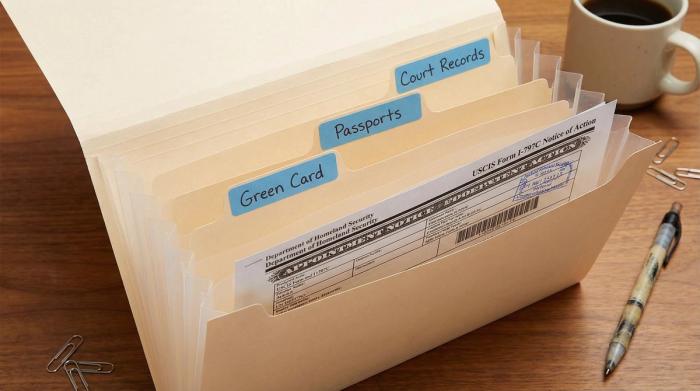
Walking in with a messy stack of papers creates a poor impression and makes it harder for the officer to help you. Here's how to organize for success:
The Folder System
Folder 1: Essential Documents
- Interview appointment notice (I-797C)
- Green card
- State ID
- Current passport
Folder 2: Passports and Travel
- All expired passports
- Travel documents (if any)
- Travel history summary (if extensive travel)
Folder 3: Situation-Specific Documents
- Marriage evidence (if 3-year rule)
- Court records (if criminal history)
- Selective Service documents (if applicable)
- Military documents (if applicable)
Folder 4: Copies for USCIS
- Copies of everything in Folders 1-3
- Organized in the same order
Label Everything
Use sticky notes or tabs to label sections. This helps both you and the officer find documents quickly. Write your A-Number on the top right corner of each page.
Create a Personal Checklist
Before your interview, go through your N-400 application question by question. For each answer that required documentation, verify you have the supporting document. Our step-by-step N-400 guide walks through every section.
What to Expect on Interview Day
Understanding the timeline helps reduce anxiety and ensures you arrive prepared.
Before You Leave Home
- Double-check your document checklist
- Review your N-400 answers (you should know what you wrote)
- Study for the civics test if you haven't already
- Eat a light meal (interviews can take 1-3 hours)
- Dress professionally but comfortably (business casual is appropriate)
Arriving at the Field Office
Plan to arrive 15-30 minutes early. Most USCIS offices are in federal buildings with security screening:
- You'll need to show your ID and appointment notice at the entrance
- Walk through a metal detector
- Bags may be X-rayed
After clearing security, check in at the reception desk and wait for your name to be called.
The Interview Process
Your interview typically lasts 20-45 minutes and includes:
- Oath: You'll be asked to swear that everything in your application is true
- Document review: The officer verifies your identity and reviews your documents
- N-400 review: The officer goes through your application, asking about each section
- English test: You'll read and write simple sentences in English
- Civics test: You'll answer 20 questions about U.S. history and government (12 correct to pass)
For tips on what officers actually ask, see our guide on N-400 interview questions.
The 2025 Civics Test: What Changed
If you filed your N-400 on or after October 20, 2025, you'll take the new 2025 civics test. Here's what's different:
The new test includes additional questions about the Federalist Papers, Alexander Hamilton, James Madison, Dwight Eisenhower, and the 10th Amendment (Federal Register, Sept. 18, 2025).
Study all 128 questions using the official USCIS materials or our comprehensive civics study guide.
The 65/20 Exception Still Applies
If you're 65 or older and have been a permanent resident for at least 20 years, you can take the civics test in your native language and only need to study 20 designated questions. Bring proof of your age (birth certificate or passport) and LPR status duration.
What If You Forget a Document?
It happens. If you arrive and realize you're missing something, here's what to expect:
Best case: The officer proceeds with the interview and asks you to mail or bring the missing document later. You'll receive a follow-up notice.
Likely case: The officer reschedules your interview to give you time to obtain the document. You won't be penalized, but you'll need to wait for a new appointment.
Rare case: If the missing document is critical (like your green card) and you can't verify your identity, the officer may not be able to proceed at all.
To avoid this situation, use the checklist in this guide and verify everything the night before. If you realize you're missing something important, call the USCIS Contact Center before your appointment to ask if you should reschedule or bring what you can.
Check Your N-400 Eligibility in 5 Minutes
Answer a few questions and find out if you qualify for U.S. citizenship today.
New for 2025: Good Moral Character Evidence
In August 2025, USCIS updated its Good Moral Character guidance to emphasize "positive attributes" rather than just the absence of misconduct. While you're not required to bring evidence of good character unless requested, having supporting documentation can strengthen your case.
Consider bringing:
- Letters from employers, neighbors, or community members vouching for your character
- Evidence of volunteer work or community involvement
- Documentation of stable employment history
- Proof of tax compliance (IRS transcripts)
- Evidence of family responsibilities and caregiving
This is especially important if you have any factors that might raise questions about good moral character, such as past arrests (even dismissed) or extended time outside the U.S.
Neighborhood Investigations Are Back
For the first time since 1991, USCIS may conduct neighborhood investigations to verify your residence and moral character. This policy was reinstated in August 2025 (USCIS Policy Manual, Vol. 12, Part F). Strong upfront documentation may reduce the likelihood of an investigation. If an officer mentions plans to contact your neighbors or employer, stay calm. This is a standard verification process, not an accusation.
Frequently Asked Questions
Every applicant needs their interview appointment notice (I-797C), green card, state-issued photo ID, all passports (current and expired), and originals of documents submitted with their N-400. Additional documents depend on your situation, including marriage evidence for 3-year applicants, court records for criminal history, and Selective Service documentation for applicable males. Check your specific requirements using our N-400 eligibility checker.
Bring both. Per 8 CFR § 316.4, USCIS officers may request originals to verify authenticity, and having copies ready speeds up the process. Essential items like your green card and passports must be originals. For documents like birth certificates and court records, bring the original plus a copy.
Yes. Your lawful permanent resident status doesn't expire when your card does. Bring the expired card, and your N-400 filing receipt extends the card's validity for 24 months. Read more about applying with an expired green card.
Most applicants should bring 3-5 years of tax transcripts or returns. Marriage-based (3-year) applicants need the last 3 years; standard (5-year) applicants may need up to 5 years. You can request transcripts free from the IRS. Understanding the costs and requirements helps you prepare properly.
The officer may proceed and request the document later via mail, reschedule your interview, or in rare cases, be unable to proceed. Call the USCIS Contact Center before your appointment if you realize something important is missing. Avoid this by using a checklist and verifying documents the night before.
Your spouse can accompany you to the building but typically cannot attend the actual interview unless you've requested an accommodation or interpreter. Children should generally stay home. Check your appointment notice for specific instructions about guests.
For straightforward cases, no. Most applicants successfully complete interviews without legal representation. However, if you have a complex history (criminal record, extensive travel, or immigration violations), consulting an attorney before your interview is wise. See our guide on filing N-400 without a lawyer.
Business casual is appropriate. Think office attire rather than formal wear. Clean, neat clothing shows respect for the process. Avoid clothing with offensive messages or images.
You get a second chance. USCIS will schedule a retest within 60-90 days. You only need to retake the portion you failed. Use the time to study with our 128 civics questions guide. If you fail twice, your application is denied, but you can reapply.
No. You surrender your green card at the oath ceremony, not the interview. The officer will examine it during your interview but return it to you. You remain a permanent resident until you take the oath of allegiance and become a citizen.
Official Sources
This guide is based on current USCIS policy and federal regulations. All information was verified against these official sources as of January 2026:
USCIS Resources
Form N-400 Official Page - Application and instructions
Form M-477 Document Checklist - Official USCIS checklist
N-400 Instructions PDF - Detailed filing guidance
The Naturalization Interview and Test - Interview overview
USCIS Policy Manual, Vol. 12, Part B, Ch. 3 - Interview requirements
USCIS Fee Schedule (G-1055) - Current fees
USCIS Processing Times - Check current wait times
2025 Civics Test Study Materials - Official study resources
Federal Regulations
8 CFR § 316.4 - Interview and document requirements
8 CFR Part 312 - Educational requirements for naturalization
8 CFR § 319.1 - Spouse of U.S. citizen requirements
Immigration and Nationality Act
INA § 316(a) - General naturalization requirements
INA § 101(f) - Good moral character definition
INA § 312(a) - English and civics requirements
Other Official Sources
Selective Service Status Information Letter - For men who didn't register
CBP I-94 Travel History - Reconstruct your travel records
2025 Civics Test Federal Register Notice - Policy announcement
Immigration law changes frequently. We monitor USCIS policy updates and revise this guide when regulations change.
About Immiva
Simplifing Immigration Process
Resources
Contact
Disclaimer: Simple Immi LLC dba Immiva is not a lawyer or a law firm and does not engage in the practice of law, provide legal advice, or offer legal representation. The information, software, services, and comments on this site are for informational purposes only and address issues commonly encountered in immigration. They are not intended to be a substitute for professional legal advice. Immiva is not affiliated with or endorsed by the United States Citizenship and Immigration Services (USCIS) or any other government agency. Your use of this site is subject to our Terms of Use.
Copyright © 2025 immiva.com (Simple Immi LLC dba Immiva)