
Published: Feb 09, 2026
N-400 Document Checklist 2026: Everything You Need to Apply
A complete list of documents you need for filing, biometrics, and your citizenship interview, with 2025 Good Moral Character updates.

By Michal
Filing Form N-400 requires different documents at three stages: when you submit your application, at your biometrics appointment, and at your citizenship interview. This checklist covers all three, plus updated good moral character guidance USCIS announced in August 2025.

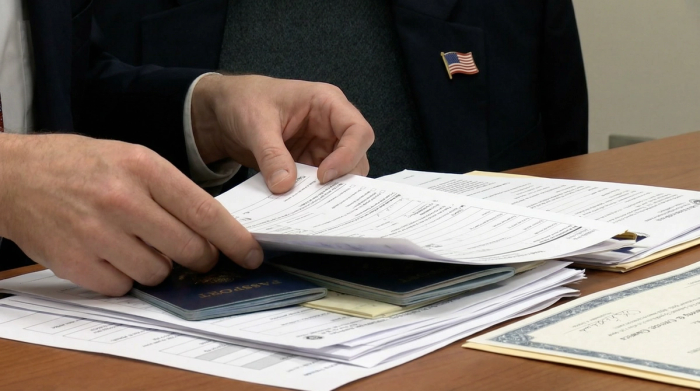
If you're getting ready to apply for U.S. citizenship, the document preparation stage is where most delays start. Missing a single form, forgetting to translate a document, or submitting the wrong copy can trigger a Request for Evidence (RFE) and push your timeline back by weeks or months.
This N-400 checklist breaks down exactly what you need at every step of the process. And because USCIS made significant policy changes in 2025, including new Good Moral Character evidence standards and resumed neighborhood investigations, some of the documents on this list may be different from what you've seen in older guides.
Before you start gathering documents, use our free N-400 eligibility checker to confirm you meet all the requirements. There's no point preparing a filing package if you're not yet eligible.
What Changed for N-400 Documents in 2025-2026
Several policy changes in 2025 directly affect what documents you should submit with your N-400. If you're using an older checklist, you may be missing critical items.
Good Moral Character (GMC) guidance update (August 2025). USCIS evaluates good moral character using a "totality of the circumstances" approach, weighing favorable and unfavorable factors (USCIS Policy Manual, Vol. 12, Part F, Ch. 2). Positive factors can include items like employment history and community involvement. This means you may choose to proactively include supporting documents even if the N-400 instructions don't specifically require them. More on this below.
Electronic payments only (October 2025). USCIS stopped accepting checks and money orders on October 28, 2025. All filing fees must now be paid by credit card, debit card, or ACH bank transfer (USCIS Fee Schedule).
New civics test (October 2025). Applications filed on or after October 20, 2025 use the expanded test with 128 civics questions, up from 100. You'll be asked 20 questions and need 12 correct (USCIS 2025 Civics Test). While this doesn't change your filing documents, it affects how you prepare for your interview.
Updated form edition (January 2025). The current Form N-400 edition date listed by USCIS is 01/20/25. Use the current edition from uscis.gov and make sure all pages you submit are from the same edition; USCIS may reject a filing if pages are missing or mixed between editions (USCIS N-400 Page).
The Core N-400 Checklist: Documents Every Applicant Needs
Regardless of your specific situation, every applicant needs these documents. They're organized by when you'll need them.
What to Submit with Your Application
- Completed Form N-400, all pages including blank ones (N-400 Instructions)
- Photocopy of your Permanent Resident Card (front AND back)
- Filing fee payment: $710 for online filing, $760 for paper filing (USCIS Fee Schedule). If you need help understanding fees, see our guide on N-400 costs and fee options
- Your A-Number written on the top right corner of every page you submit
Tip: Filing online saves you $50 and reduces the chance of errors. Our complete guide to filing N-400 without a lawyer walks you through the full process.
What to Bring to Your Biometrics Appointment
Your biometrics appointment is often scheduled within a few weeks after USCIS accepts your application, but timing varies by applicant and location.
- Your biometrics appointment notice (Form I-797C)
- A valid government-issued photo ID (driver's license, passport, or state ID)
You don't need to bring photos. USCIS captures your photo and fingerprints at the Application Support Center (ASC). The biometrics fee is included in your filing fee, so there's nothing additional to pay (USCIS Fee Schedule).
What to Bring to Your Citizenship Interview
This is where you'll need the most documents. Bring originals of everything you submitted as copies, plus:
- Your interview appointment notice
- Permanent Resident Card (Green Card)
- State-issued photo ID or valid passport
- All valid and expired passports
- Any travel documents issued since you became a permanent resident
- Originals of all documents you submitted as copies with your application
For a detailed breakdown of what the interview itself looks like, see our guide on N-400 interview questions USCIS officers actually ask.
Ready to File Your N-400?
Immiva walks you through the application step by step, catches errors before you submit, and keeps your documents organized.
Additional Documents by Applicant Type
Beyond the universal requirements, you'll need specific documents depending on how you qualify for naturalization.
Marriage-Based Applicants (3-Year Rule)
If you're applying based on marriage to a U.S. citizen and three years of permanent residence (INA § 319(a)), include:
- Proof your spouse has been a U.S. citizen for at least three years (birth certificate, naturalization certificate, or U.S. passport)
- Your current marriage certificate
- Evidence of living together in marital union: joint tax returns, shared bank statements, lease or mortgage in both names, joint insurance policies, birth certificates of children born together
If you've been divorced and remarried, bring divorce decrees from all prior marriages for both you and your spouse.
Military Service Applicants
Active duty members and veterans may qualify for expedited or fee-free naturalization under INA § 328 or § 329. Include:
- DD Form 214 (Certificate of Release or Discharge)
- N-426 (Request for Certification of Military Service), completed by your commanding officer or personnel office
- Evidence of current or prior military service
Applicants with a Disability Exemption
If a physical or mental disability prevents you from taking the English or civics test, include:
- Form N-648 (Medical Certification for Disability Exceptions), completed and signed by a licensed medical professional
- The doctor must describe the specific disability and explain how it prevents you from learning English or civics (USCIS Policy Manual, Vol. 12, Part E, Ch. 2)
Not sure which category applies to you? Use our free N-400 eligibility checker to see which requirements you need to meet.
New Good Moral Character Evidence Requirements
This is the biggest document change for 2026 applicants, and it's something you won't find in most older guides.
Since August 2025, USCIS officers assess good moral character based on the "totality of circumstances," not just the absence of criminal behavior (USCIS Policy Manual, Vol. 12, Part F, Ch. 2). That means it's now in your interest to include positive evidence of your character, even though the N-400 instructions don't specifically list these items.
Documents that can strengthen your application:
- Testimonial letters from neighbors, employers, religious leaders, or community members who can speak to your character
- Proof of community involvement: volunteer work records, church or mosque membership, participation in local organizations, school involvement for your children
- Employment records: pay stubs, employer letters, or tax records showing stable employment
- Tax compliance: IRS tax return transcripts for the statutory period (usually the last 5 years, or 3 years if applying based on marriage). You can request free transcripts at irs.gov
- Evidence of family responsibilities: school records for children, medical care records, family financial support documentation
Important: While none of these documents are technically "required," including them proactively demonstrates the positive attributes that USCIS now evaluates. Think of it as building a case in your favor before anyone asks questions.
Preparing for a Potential Neighborhood Investigation
USCIS resumed neighborhood investigations in August 2025, after roughly a three-decade pause. An officer may conduct neighborhood or workplace inquiries in some cases and speak with people who know you to help verify eligibility factors such as residence and good moral character.
You can't control whether an investigation happens, but you can reduce the chance of one being triggered:
- Submit strong upfront documentation of your residence (utility bills, bank statements with your address, lease or mortgage records)
- Include testimonial letters that confirm your address and community ties
- Make sure your travel records are complete and consistent with your claimed physical presence. For help calculating your time in the U.S., see our guide on N-400 physical presence requirements
If you have nothing to hide, an investigation isn't something to fear. But solid documentation makes it less likely USCIS will feel the need to verify your claims through third parties.
Copies vs. Originals: What to Submit and What to Bring
This is one of the most common sources of confusion, so here's the straightforward rule:
When filing: Submit legible photocopies of all supporting documents. Do not send originals unless the form instructions specifically require them (N-400 Instructions).
At your interview: Bring the originals of every document you submitted as a copy. The officer will compare them side by side.
Translation Requirements for Foreign Documents
Any document in a language other than English must include a certified English translation (8 CFR § 103.2(b)(3)). The translation must include:
- The translator's statement certifying the translation is complete and accurate
- The translator's signature and date
- A statement that the translator is competent in both languages
Notarization is NOT required. And any competent bilingual person can do the translation, not just a professional translator. That said, professional translations are less likely to be questioned.
Document Specifications
Standard U.S. letter size (8.5" x 11"), black ink photocopies are acceptable. If documents are too large or small, resize them to letter format. Most applicants do not submit passport photos with Form N-400 because USCIS takes your photo at the biometrics appointment, but USCIS may request physical passport photos after you file. Certain applicants who reside outside the United States (including some military-related filings) must submit two passport-style photos.
How to Document Your Travel History
The N-400 asks you to list every trip outside the United States during the last five years (three years for marriage-based applicants). You must include every trip that lasted 24 hours or more (USCIS Policy Manual, Vol. 12, Part D, Ch. 3).
If you travel frequently, this can be one of the hardest parts of the application. Here's how to reconstruct your records:
Check your passports. Look at entry and exit stamps for each country. Check all valid and expired passports.
Request your I-94 records. Go to i94.cbp.dhs.gov to download your travel history. This covers arrivals and departures at U.S. ports of entry.
Submit a CBP FOIA request. If your I-94 records are incomplete, you can request a more detailed travel history from Customs and Border Protection through a Freedom of Information Act request.
Check airline and booking records. Email confirmations, credit card statements, and frequent flyer accounts can help fill in gaps.
Warning: Don't guess on dates. If USCIS finds inconsistencies between your travel records and your claimed physical presence, it can trigger an RFE or even raise moral character questions. Get it right before you file.
For trips longer than six months, you'll also need evidence that you maintained your U.S. residence, that your employment wasn't terminated, and that your immediate family remained in the country.
Criminal History Documentation
You must disclose every arrest, citation, or charge on your N-400, even if the charges were dropped, dismissed, sealed, or expunged (USCIS Policy Manual, Vol. 12, Part F). The only exceptions are minor traffic violations that didn't involve alcohol, drugs, or arrest.
If you have any criminal history, include:
- Certified court disposition for every arrest or charge
- Sentencing records
- Probation or parole completion documentation
- Police reports (if charges were not filed)
To obtain old court records, contact the clerk of court in the jurisdiction where the incident occurred. Some courts allow online record requests. If you can't locate records, request a state criminal background check from the state's department of justice or equivalent agency.
For specific situations, we have detailed guides on applying for citizenship with a DUI and how to avoid common N-400 mistakes related to criminal history disclosure.
Common Document Mistakes That Cause Delays
Based on the most frequent N-400 errors that lead to denials, here are the document-related mistakes to watch out for:
Forgetting the back of your Green Card. You need copies of both sides. Missing the back is one of the most common RFE triggers..
Incomplete travel history. Listing only long trips and skipping weekend border crossings. Include every trip lasting 24+ hours.
Missing translations. Foreign language documents without certified translations will be rejected.
Sending originals instead of copies. USCIS may not return original documents. Keep your originals for the interview.
Failing to include A-Number on every page. This is how USCIS connects your supporting documents to your application.
Not including new Good Moral Character evidence. Under the August 2025 policy, failing to include positive character evidence means relying entirely on the officer's assessment without any input from you.
Don't Risk Filing with Missing Documents
Immiva's guided application checks for common errors and missing documents before you submit. No legal jargon, no guesswork.
How to Organize Your N-400 Checklist
A well-organized filing package shows USCIS you're serious and makes the officer's job easier. Here's a simple system:
Folder 1: Application. Form N-400 (all pages), fee payment confirmation, cover letter (optional but recommended).
Folder 2: Identity and status. Green Card copies (front and back), passport copies, name change documents (if applicable).
Folder 3: Eligibility evidence. Marriage certificates and spouse citizenship proof (for 3-year applicants), physical presence records, travel history documentation.
Folder 4: Good Moral Character evidence. Tax transcripts, testimonial letters, community involvement records, employment verification.
Folder 5: Situation-specific documents. Court records, Selective Service documentation, military records, N-648 medical certification, or any other documents specific to your case.
Label each folder and arrange documents chronologically within each section. With this N-400 checklist in hand and your documents properly organized, you're ready to file with confidence.
If you'd like help organizing and filing your application, see how Immiva works or start your N-400 application directly.
Frequently Asked Questions
Yes. An expired Green Card does not affect your eligibility to apply for citizenship. When USCIS accepts your N-400, the receipt notice (I-797C) automatically extends your Green Card validity for 24 months (USCIS Policy Alert). Use the receipt along with your expired card as proof of status.
USCIS can request tax information at your interview to verify good moral character (USCIS Policy Manual, Vol. 12, Part F, Ch. 2). Bring IRS tax return transcripts for the last five years (three if applying based on marriage). You can download these for free from your IRS online account. For more on fees and financial requirements, see our guide on N-400 costs explained.
Contact the clerk of court in the jurisdiction where the arrest occurred. If the court has purged the records, get a letter from the court stating the records are unavailable. You can also request your FBI Identity History Summary (rap sheet) by submitting fingerprints to the FBI. Never omit an arrest from your application just because you can't find the records.
Both. Submit photocopies of supporting documents with your N-400 when you file. Then bring the originals to your interview so the officer can verify them. Don't assume USCIS will wait until the interview to review your case.
Acceptable proof includes a U.S. birth certificate, Certificate of Naturalization, Certificate of Citizenship, or a valid U.S. passport. If your spouse naturalized, bring their naturalization certificate. If born abroad to U.S. citizen parents, a Consular Report of Birth Abroad (FS-240) works too.
If you have documents from the USSR, Yugoslavia, Czechoslovakia, or similar nations, submit them as-is with certified English translations. On the N-400 form, list the current country name (e.g., "Russia" instead of "USSR") and note the historical country name if relevant. USCIS is familiar with these situations.
Minor traffic violations like speeding tickets generally don't need to be reported unless they involved alcohol, drugs, or resulted in arrest. However, DUI/DWI offenses, reckless driving with arrest, and any violation that led to jail time must be disclosed. When in doubt, disclose it. Our guide on citizenship with a DUI covers this in detail.
If USCIS issues a Request for Evidence, you'll typically have 87 days to respond. Respond promptly with the requested documents. An RFE isn't a denial, but it does add time to your case. Use our step-by-step N-400 guide to make sure your initial application is complete.
Yes. You can apply for citizenship while your I-751 (petition to remove conditions on residence) is pending. USCIS may schedule a combined interview to adjudicate both applications. Bring all I-751 related documents to your N-400 interview. For details on the I-751 process, see our guide to removing conditions on your Green Card.
Since October 2025, USCIS only accepts credit cards, debit cards, or ACH bank transfers. For online filings, you'll pay directly through your USCIS account. For paper filings, include Form G-1450 (Authorization for Credit Card Transactions). Read our guide on how to pay USCIS filing fees for step-by-step instructions.
Official Sources
This guide is based on current USCIS policy and federal regulations. All information was verified against these official sources as of February 2026:
USCIS Resources
- USCIS Form N-400 Official Page
- Form N-400 Instructions (PDF)
- USCIS Document Checklist M-477 (PDF)
- USCIS Fee Schedule (G-1055)
- USCIS Processing Times
- USCIS Policy Manual, Volume 12: Citizenship and Naturalization
- 2025 Civics Test Study Resources
- Fee Waiver Form I-912
Federal Regulations
- 8 CFR Part 316 - General requirements for naturalization
- 8 CFR § 103.2(b)(3) - Translation requirements for foreign documents
Immigration and Nationality Act
- INA § 316(a) - General naturalization requirements
- INA § 319(a) - Naturalization for spouses of U.S. citizens
- INA § 101(f) - Good moral character definition
- INA § 312(a) - English and civics requirements
About Immiva
Simplifing Immigration Process
Resources
Contact
Disclaimer: Simple Immi LLC dba Immiva is not a lawyer or a law firm and does not engage in the practice of law, provide legal advice, or offer legal representation. The information, software, services, and comments on this site are for informational purposes only and address issues commonly encountered in immigration. They are not intended to be a substitute for professional legal advice. Immiva is not affiliated with or endorsed by the United States Citizenship and Immigration Services (USCIS) or any other government agency. Your use of this site is subject to our Terms of Use.
Copyright © 2025 immiva.com (Simple Immi LLC dba Immiva)